Whether you are involved in electrical engineering, electrical installation, or DIY home renovation, you have likely seen this inconspicuous component—the cable lug
It is usually installed at the end of a cable, securely connecting the conductor to equipment, busbars, or terminal blocks through crimping or mechanical fastening.
Many people think: “Isn’t it just a copper lug? Just buy any one and crimp it on.”
In fact, in electrical failures, poor contact, non-standard crimping, and incorrect terminal selection are often more likely to cause heating, oxidation, and even equipment burnout than the cable itself.
So, what are the common cable lugs on the market? What are the differences between various models? This article will explain it all at once.
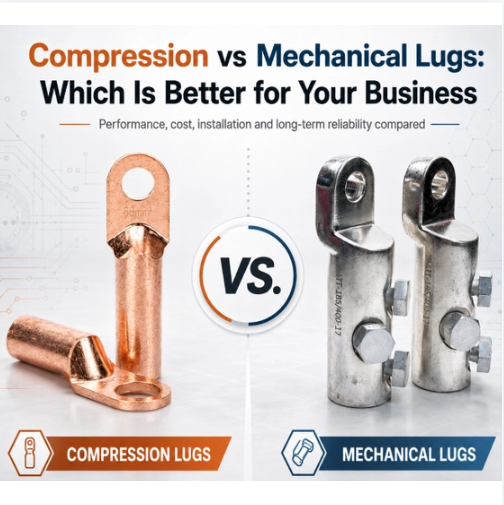
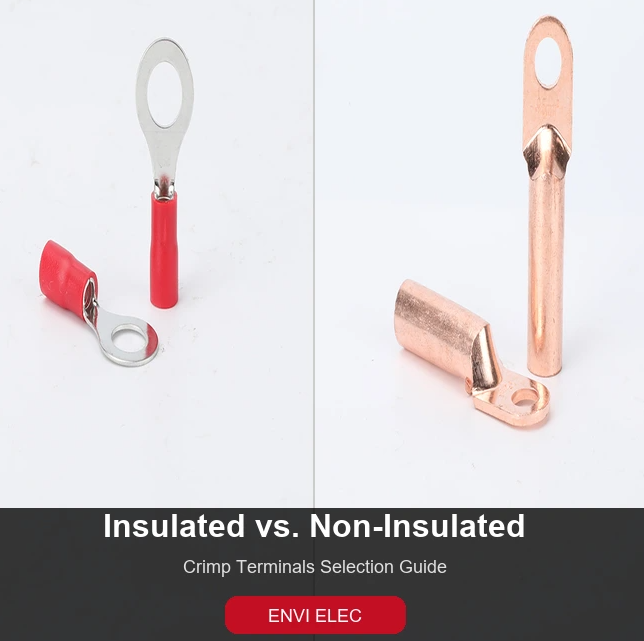
This is the most widely used category, commonly known as “copper lugs” .
They all need to be paired with crimping tools to firmly crimp the terminal to the conductor, rather than relying on screws to directly clamp the wire.
The DT type is one of the most common standard copper terminals in the power industry.
It features a closed circular hole structure with a relatively long crimping barrel, suitable for multi-strand copper wires and cables with a larger cross-sectional area. It is widely used in distribution cabinets, control cabinets, power equipment, and other scenarios.
Features: Stable electrical conductivity, large crimping area, high current-carrying capacity, suitable for long-term fixed connections. The main circuits in many factory distribution cabinets use the DT series.
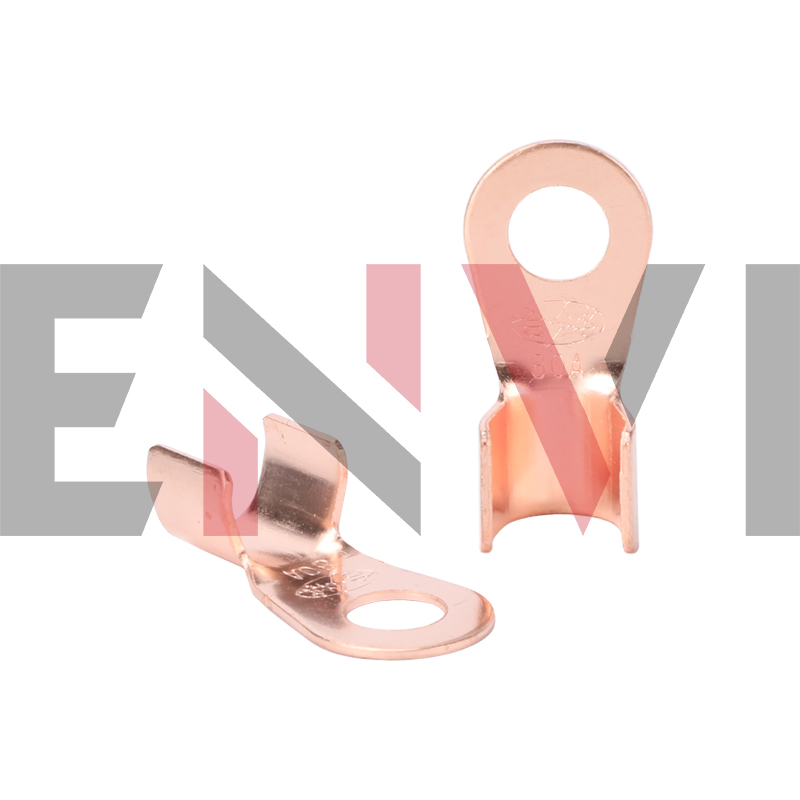
The biggest feature of the OT terminal is its open design for the installation hole (U-shaped or fork design).
During installation, there is no need to completely remove the bolt; simply loosen the bolt slightly, insert the terminal, and then tighten it.
Therefore, it is particularly suitable for:Frequent maintenance and inspection,Narrow installation spaces,Control cabinets, inverters, relays, and other equipment
However, compared to closed circular hole terminals, OT terminals are more suitable for control circuits or small to medium current circuits. For environments with significant vibration, ensure that the bolts are tightened to the specified torque.
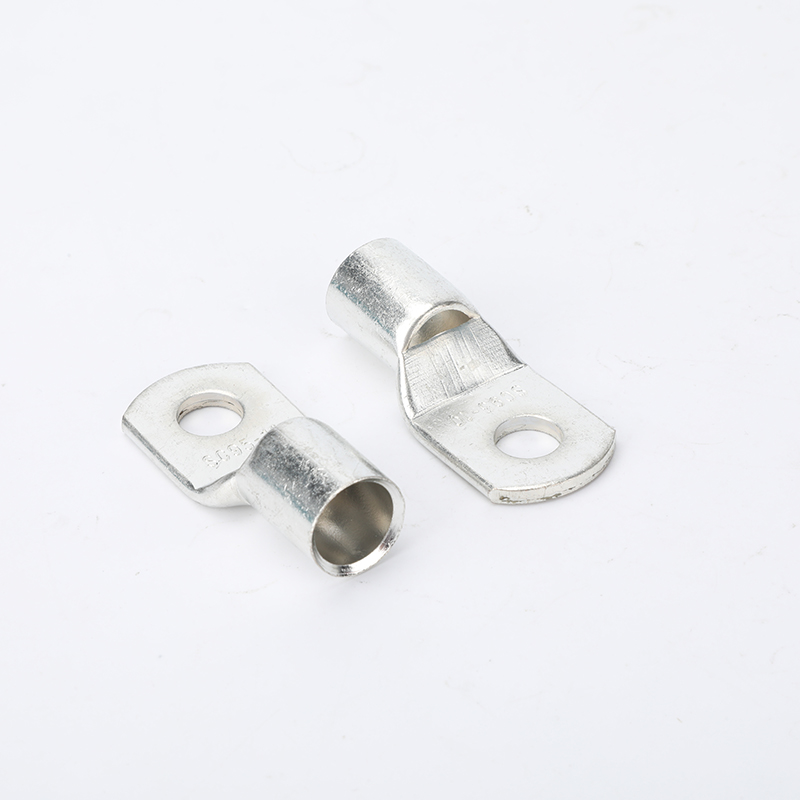
The SC/JG series is also a very common type of copper terminal on the market.
Compared to the DT series, SC/JG terminals usually have a shorter crimping barrel and a more compact overall structure, making them suitable for low-voltage power distribution, equipment wiring, and general industrial scenarios.
SC/JG terminals are made of T2 copper tubes and are surface-tinned to improve corrosion resistance. In many export products, the SC/JG series is also a frequently used model.
If an aluminum-core cable needs to be connected to a copper busbar, you cannot let copper and aluminum touch directly.
The reason is simple: long-term contact between copper and aluminum, especially in humid environments, easily causes electrochemical corrosion, leading to increased contact resistance, heating, and ultimately affecting connection reliability.
The DTL terminal is designed precisely to solve this problem. It typically uses an aluminum barrel to crimp the wire and a copper palm to connect to the equipment. The two parts are connected through processes like friction welding, taking both electrical conductivity and long-term reliability into account. When purchasing, it is recommended to prioritize products using reliable connection processes rather than just focusing on price.
Besides the standard DTL series, various structural forms of copper-aluminum connecting terminals have emerged on the market to meet different working conditions and installation requirements. Although their appearances may differ, their design concepts and working principles remain consistent: achieving a safe and stable electrical connection between copper and aluminum conductors through a composite connection structure.
For home renovations and small equipment installations, not all connections require hydraulic crimping. In recent years, quick-connect terminals have become increasingly popular.
Many renovation electricians have encountered this product. It uses a spring mechanism to clamp the wire, allowing the connection to be completed without crimping pliers.
Advantages: Fast wiring speed and less likelihood of damaging the wire core. It is particularly suitable for lighting, control circuits, and home low-voltage wiring.
However, it cannot replace all crimp terminals. For long-term high-current and high-load circuits, you must still make logical selections based on product specifications and design requirements.
What many electricians refer to as pin terminals, tubular terminals (ferrules), or cold-pressed terminals all fall into this category.
They are mainly used for multi-strand flexible wires. After crimping, they:Prevent strands from spreading apart,Increase the contact area,Improve wiring reliability
They can be seen almost everywhere in control cabinets containing PLCs, relays, contactors, and inverters. Whether it is mandatory to use cold-pressed terminals for equipment adopting screw crimping methods should be determined according to equipment manuals, product standards, and engineering specifications.
To facilitate your future purchasing and construction, I have compiled a basic selection quick-reference table:
| Terminal Category | Representative Model | Core Advantage | Applicable Scenarios / Construction Notes |
| Pure Copper Crimp | DT, OT Type | Large current capacity, extremely stable connection | High-voltage main lines, distribution cabinets / Requires dedicated crimping pliers |
| Bimetallic Transition | DTL Type | Prevents electrochemical corrosion | Copper-to-aluminum wire splicing / Must ensure friction welding process |
| Crimpless Quick-Connect | Spring Terminal (e.g., 221) | Extremely simple installation, does not damage wire core | Low-voltage, lighting branches / Strictly prohibited for high-power circuits |
| Cold-Pressed Terminal | Pre-insulated Terminal | Protects flexible wires from being cut by screws | Flexible wires connecting to circuit breakers, sockets / Complies with mandatory national standards |
Finally, here are three tips for avoiding pitfalls when purchasing:
Check the material and feel: Weigh it in your hand. A good terminal has thick walls and a smooth finish; pure copper (red copper) appears reddish, while brass appears whitish. Those that are overly shiny might be “copper-plated iron,” which will be exposed with a single scratch of a file.
Match the wire diameter: The terminal hole diameter is not “one-size-fits-all” just because it’s larger. You must strictly choose according to the cable’s cross-sectional area (square millimeters), otherwise, it will absolutely not crimp tightly.
Match the tools: Only the correct crimping pliers (hydraulic or manual) paired with qualified terminals—providing a solid feel and no burrs or flash after crimping—can form a truly reliable “cold weld” connection.
Electrical connections are no small matter; a tiny cable lug is the most critical “joint” in the circuit. Connected well, it will be trouble-free for a decade; connected poorly, it can trip or heat up in minutes. Next time you deal with wiring, don’t just grab a random one and slide it on!

With extensive experience, excellent craftsmanship, and superior customer service, we meet various technical requirements to satisfy our customers and have gained widespread