
Quick answer
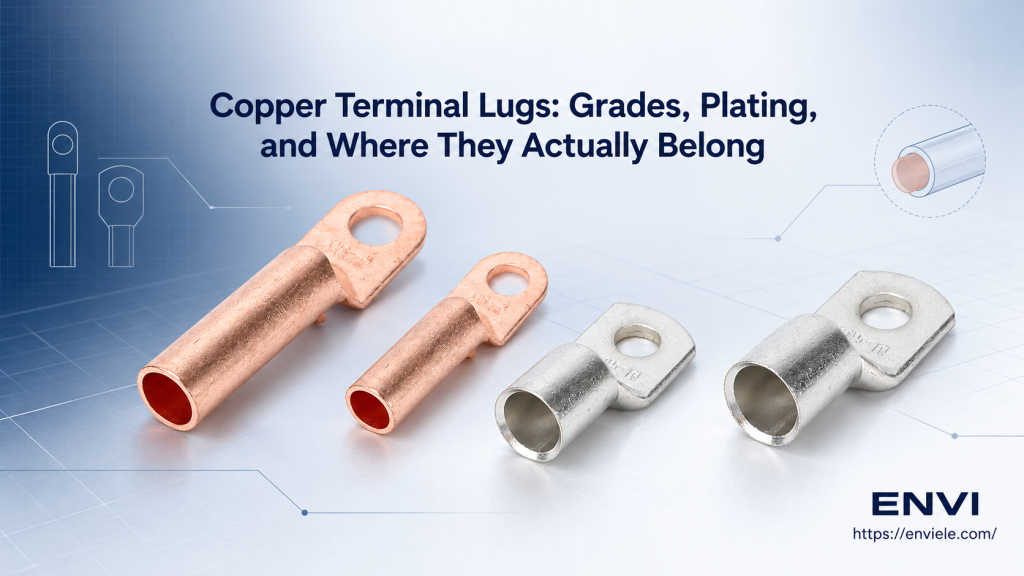
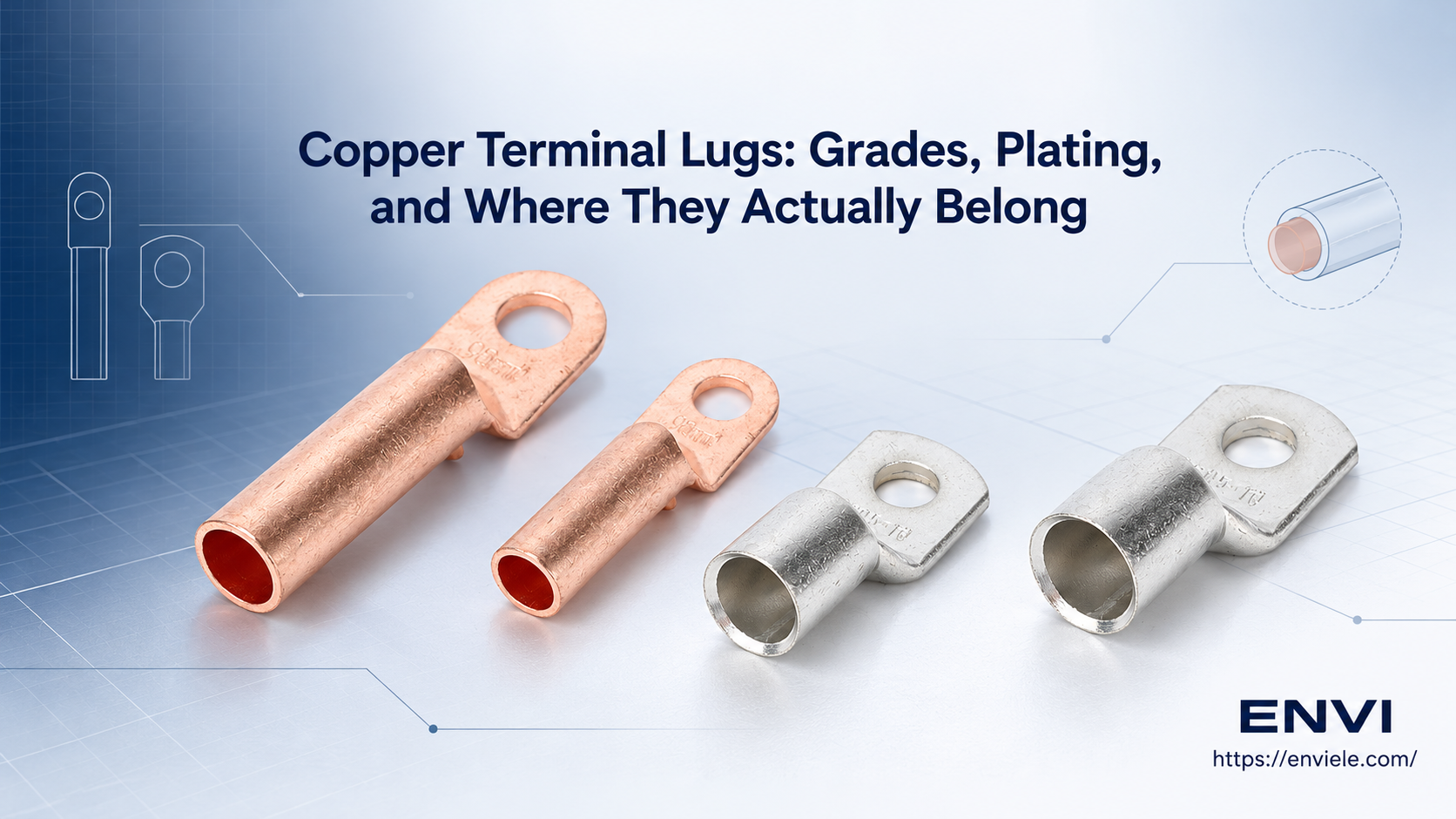
A copper terminal lug is a compression terminal made from copper or a copper alloy, and its performance is set by two choices that rarely appear on a quotation: the copper grade and the surface finish. Specify T2 (GB/T 5231) or C11000 ETP copper at 99.90 % minimum, choose tin plating at 3–10 µm for general industrial and outdoor work, nickel at 2–5 µm above 150 °C or in ammonia-bearing air, and bare copper only where a dry, controlled panel makes plating redundant.
Grade decides whether the barrel cracks when you crimp it. Plating decides whether the joint is still low-resistance after five humid summers.
Procurement teams spend most of their attention on price per piece and delivery date, then discover eighteen months later that the reason one supplier’s lugs run eight degrees hotter is not the design but the fact that the barrel was drawn from recycled copper with a higher residue content and no stress relief. This article separates the three specification layers that actually control copper terminal lug behaviour — grade, plating and form — and then maps each one to the terminals where it belongs.
In this article
1. What a copper terminal lug is
2. Copper grades and why they matter
3. Bare, tin or nickel plating
4. Lug types and where they belong
5. Copper vs aluminium vs bimetallic
6. FAQs
A copper terminal lug is a one-piece copper terminal with a tubular barrel for the conductor and a flat palm for the equipment stud. It is installed by compression — a hexagonal or indented crimp applied with a matched die — and it terminates the conductor by cold welding: under sufficient pressure the copper grains of barrel and strand flow into each other, and the resulting joint is metallurgical rather than merely frictional.
That cold-welding mechanism is why the copper grade is not a trivial detail. Compression only produces a sound joint if the barrel is soft enough to deform without cracking and hard enough not to over-compress. Both properties come from the mill’s annealing schedule, not from the drawing.
Three designations cover almost all industrial cable lugs worldwide. They are not interchangeable in performance even when they are interchangeable in a drawing tolerance.
T2 is the Chinese standard grade for electrical copper: 99.90 % minimum copper, with controlled oxygen content around 0.02–0.06 %. The oxygen is deliberate. It combines with residual impurities during melting and improves machinability and chip breakage, which is why T2 is the workhorse grade for drawn tube, forged palms and CNC-machined lugs. The equivalent European designation is E-Cu57 or E-Cu58 under EN 13601. If a supplier says “T2 copper” without a mill certificate, the useful question is not the grade name but the measured conductivity and the elongation at break.
C11000 electrolytic tough pitch copper is the North American equivalent of T2 and is what most UL-listed lugs are made from. Conductivity is nominally 101 % IACS in the annealed condition. In practice, T2 and C11000 are close enough that a project can usually accept either, but a UL-listed assembly must use the grade named in the listing — substituting a “similar” copper voids the certification.
Oxygen-free grades (C10100, C10200, TU1) remove the oxygen to avoid hydrogen embrittlement in reducing atmospheres. They are specified for vacuum equipment, some hydrogen-cooled generator connections and high-reliability aerospace assemblies. They cost more, machine less freely, and add nothing to a standard LV distribution lug. Paying for OFC on a building feeder is a specification error in the expensive direction.
| Grade | Cu content | Conductivity | Where it belongs |
|---|---|---|---|
| T2 / E-Cu | ≥99.90 % | ~58 MS/m | General industrial, panels, switchgear |
| C11000 / ETP | ≥99.90 % | ~58 MS/m (101 % IACS) | UL / North American projects |
| C10100 / OFC | ≥99.99 % | ~58.5 MS/m | Vacuum, hydrogen, aerospace |
| Brass (H62 etc.) | ~62 % Cu | ~15–27 % IACS | Mechanical clamps, not current-carrying barrels |
Brass belongs in the comparison for a reason: it machines faster and looks identical after plating, so it appears in low-cost lugs advertised as copper. Its conductivity is roughly a quarter of copper’s — acceptable in a clamp body, unacceptable in a 400 A barrel.
Copper does not fail by rusting; it fails by tarnishing. In sulphur-bearing air — which includes most industrial estates, ports and anything within a kilometre of rubber processing — copper forms a copper sulphide film that is a poor conductor. The film is thin, but at a bolted interface the entire contact resistance lives in a few micrometres of surface, so a tarnish layer that would be invisible on a busbar is significant inside a terminal palm.
Bare copper gives the lowest initial contact resistance and no plating adhesion risk. It is the right choice for dry, temperature-controlled enclosures, for joints that are made immediately after brushing, and for applications where the palm is clamped between large copper busbars at high pressure. It is the wrong choice for anything stored on site for months before installation, because the tarnish arrives before the installer does.
Tin is the industrial default. It is solderable, it stays oxide-free in normal atmospheres, it suppresses the copper sulphide growth, and it is galvanically compatible with aluminium — which matters more than most buyers realise, because a tin-plated copper palm bolted to an aluminium busbar behaves far better than a bare copper one. A 5 µm nominal deposit is the usual commercial specification; below 3 µm, porosity starts to matter and pinhole corrosion appears at the edges of the palm.
The visible trade-off is colour. A tin-plated lug is silver-grey, not copper-coloured, which is why buyers sometimes assume they have been sent aluminium parts. The guide to plated electrical connectors explains the appearance question in more detail, and the SC tinned copper terminal cable lug series is the standard reference for this finish.
Nickel is specified for heat and chemistry rather than for appearance. It holds up above 150 °C where tin begins to diffuse into the copper substrate, and it resists ammonia and chloride environments that attack tin. The classic applications are electrode connections in resistance welding, furnace and kiln terminations, and marine or chemical-plant panels. Nickel has higher contact resistance than tin, so it is not the default for high-current bolted joints.
| Environment | Finishing choice | Note |
|---|---|---|
| Sealed panel, controlled room | Bare copper | Lowest resistance, lowest cost |
| General industrial, indoor | Tin 3–5 µm | Standard commercial spec |
| Outdoor, coastal, high humidity | Tin 8–10 µm | Thicker deposit tolerates porosity |
| Copper palm on aluminium bar | Tin (never bare) | Slows the galvanic couple |
| Above 150 °C | Nickel 2–5 µm | Tin diffuses and dulls at temperature |
| Ammonia / chemical plant | Nickel | Tin is attacked by ammonia |
Need a plating spec written down?
ENVI supplies copper terminal lugs with mill certificates and plating thickness reports, so your incoming inspection has something to measure against. Tell us the environment and we will propose the finish.
Form follows the terminal. Four families do most of the work in industrial equipment.
The DT type — a plain tubular barrel with a flat palm — is the baseline for LV power distribution. It is compact, cheap, and crimps into a hexagonal profile that survives vibration. It is used wherever the joint is subsequently covered by heat-shrink or sits inside an enclosure, so no additional insulation is needed on the lug itself.
The insulated families serve fine-strand flexible cable in control and instrument circuits. The RV ring is the general-purpose choice for a bolted stud; the SV spade allows a joint to be slipped under a screw without full removal, which is why it dominates terminal blocks and relay bases. Both depend on the sleeve for touch protection, so the sleeve material matters — nylon resists higher temperature and abrasion than PVC, and the RV series insulated ring terminals are a practical reference for the difference.
Two bolts in line stop the palm from rotating. On a single-hole joint, a poorly torqued bolt lets the cable swing and the palm crawl; on a double-hole joint the geometry resists it. Double-hole lugs belong on transformer LV terminals, large breaker connections and anywhere the cable load is significant — the DTS double-hole parallel cable lug is the standard parallel-palm form.
Palm dimensions are not universal. DIN 46235 palms are wider and thicker for a given conductor size, with the barrel length set by the DIN table; JIS C 2805 palms are narrower with a shorter barrel and a different bolt-hole spacing, matched to Japanese equipment. Mixing them is the single most common import error: the lug fits the cable perfectly and does not fit the terminal. Ask for the palm drawing, not just the cross-section, and check it against the equipment manufacturer’s stud pattern.
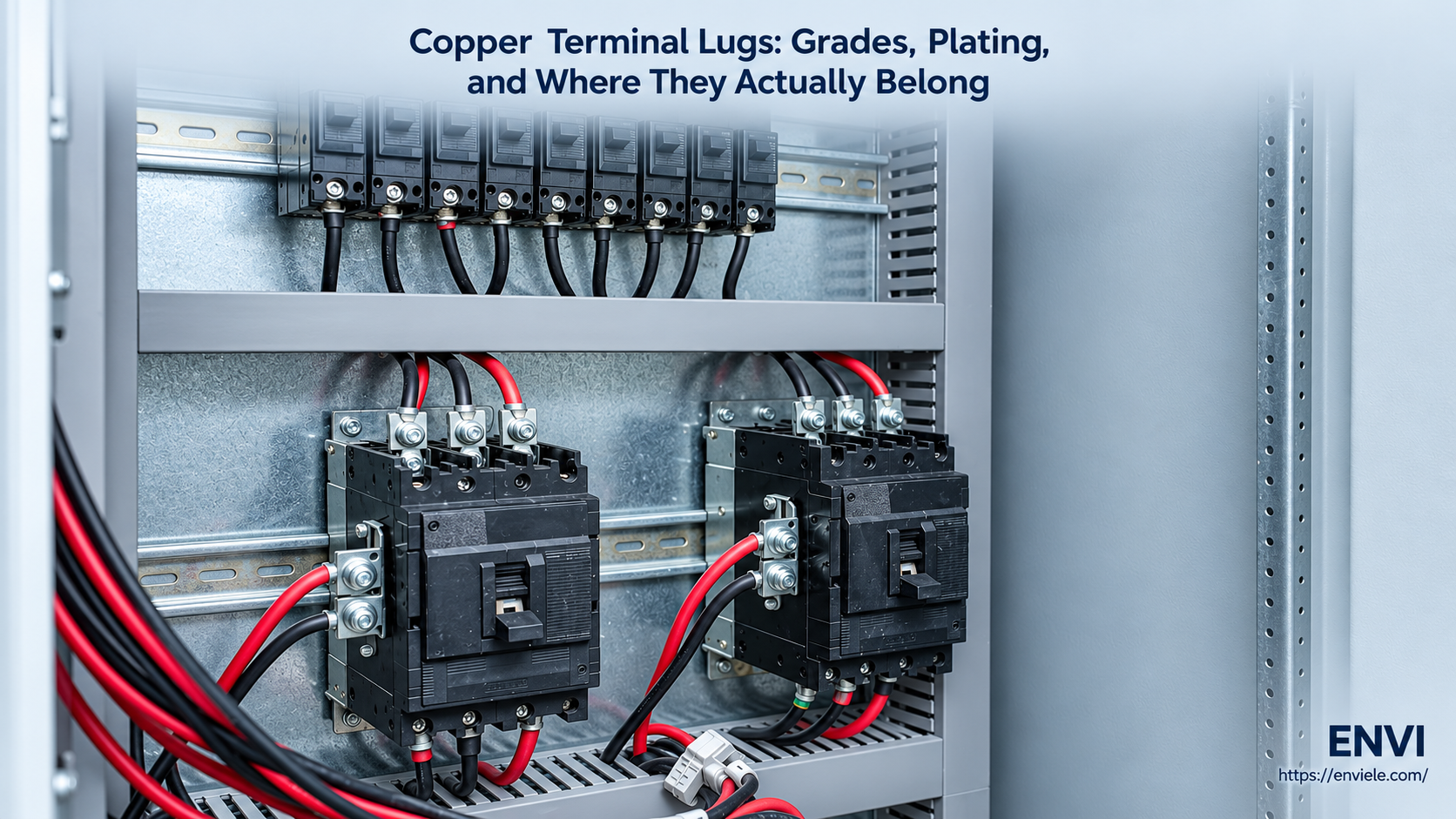
Copper wins on conductivity, ductility and joint stability. Aluminium wins on weight and cost. Bimetallic wins only where the two must meet.
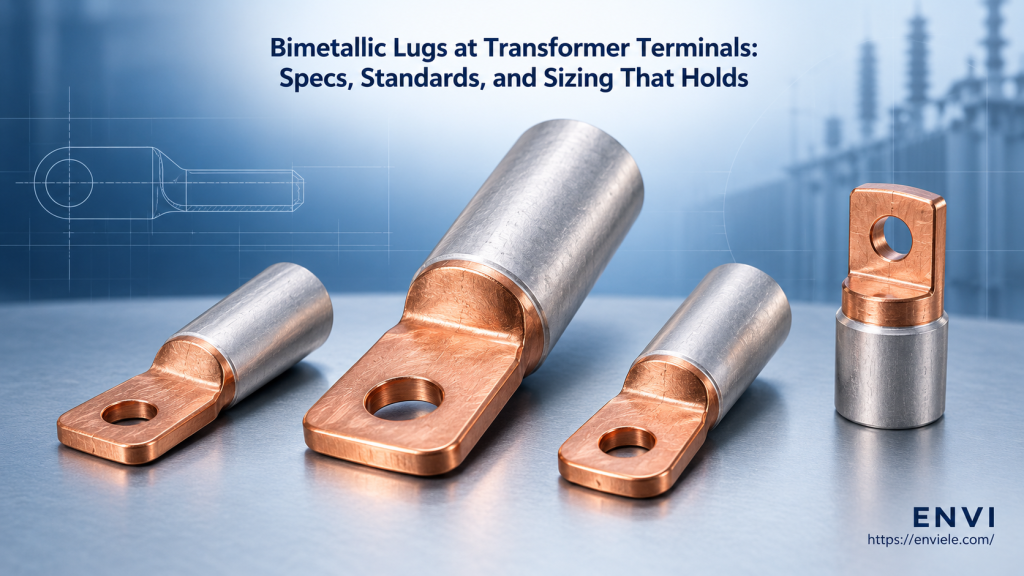
Choose copper when the conductor is copper, when the terminal is copper or brass, when space is tight, or when the joint will be cycled heavily and re-torquing is impractical. Choose aluminium when the conductor is aluminium and the terminal is aluminium — typically overhead line work and long feeders where weight drives structure cost. Choose a bimetallic lug when an aluminium conductor terminates on copper equipment: the transition is made in the factory by friction welding, where pressure and temperature produce a metallurgical bond that the field cannot reproduce, and the two metals are never separated again.
The failure mode to avoid is the “temporary” direct Cu-Al bolt-up. It works for a season. Then differential expansion — copper at roughly 17 × 10-6/K against aluminium at 23 × 10-6/K — loosens the joint while the galvanic couple corrodes the aluminium face. By the time an infrared survey finds it, the palm is often pitted beyond reuse.
The complete dimensional and material range, including bare, tinned and insulated variants, is listed in the cable lug product category.
Tin plating suppresses the copper sulphide tarnish that raises contact resistance in industrial and coastal air, it keeps the surface solderable, and it is far more compatible with aluminium mating surfaces than bare copper. The cost premium over bare copper is small, which is why tin is the default commercial finish for copper terminal lugs.
Not directly. A copper barrel crimped onto an aluminium conductor puts the two metals in contact at the highest-current interface in the circuit, and the aluminium becomes the sacrificial anode as soon as moisture arrives. Use a bimetallic lug with an aluminium barrel for the conductor and a copper palm for the terminal, or an aluminium lug if the terminal is also aluminium.
T2 (GB/T 5231) or C11000 ETP copper at 99.90 % minimum covers nearly every industrial requirement, with conductivity near 58 MS/m and enough ductility to crimp without cracking. Oxygen-free grades are only justified for vacuum or hydrogen-rich service. Avoid brass for current-carrying barrels — its conductivity is roughly a quarter of copper’s.
Bare copper has the lowest initial contact resistance, so it is better in a dry, sealed enclosure where it will be installed promptly. Plated lugs are better almost everywhere else, because the failure mechanism that actually occurs in service is surface tarnish and corrosion, not initial resistance. Choose bare for controlled panels and tin for everything that sees humidity, sulphur or time in storage.
Copper terminal lugs are simple parts with three specification layers, and each layer maps cleanly to a decision. Grade sets the crimp behaviour and the conductivity: T2 or C11000 for almost everything, OFC only for special atmospheres. Plating sets the service life: bare for sealed panels, tin for industry and weather, nickel for heat and chemistry. Form sets the fit: tubular for power, insulated for control, double-hole for transformer and breaker terminals, and DIN or JIS palm according to what the equipment was built to.
Write those three lines into your purchase specification and the lug stops being a commodity line item. It becomes a component with a measurable, repeatable performance claim — which is the only thing that protects a twenty-year design life.
Specify with confidence
ENVI manufactures copper terminal lugs from T2 copper to GB/T 5231, with bare, tin and nickel finishes and full dimensional drawings on request. OEM marking, custom palm geometry and mixed-container orders are all available from the factory.
Tinned vs bare copper lugs for breaker terminals: 6 key differences
Why 99.9 % pure copper matters for electrical connections
Seamless vs brazed seam copper lugs
DT copper terminal cable lugs

With extensive experience, excellent craftsmanship, and superior customer service, we meet various technical requirements to satisfy our customers and have gained widespread
 Optimized by Seraphinite Accelerator