
Choosing the right copper cable lug is one of the smallest decisions in a panel build — and one of the easiest to get wrong. In a compact distribution box where every millimetre of clearance matters, the choice between a 90-degree (right angle) lug and a straight lug decides whether your wiring fits, stays cool, and passes inspection.
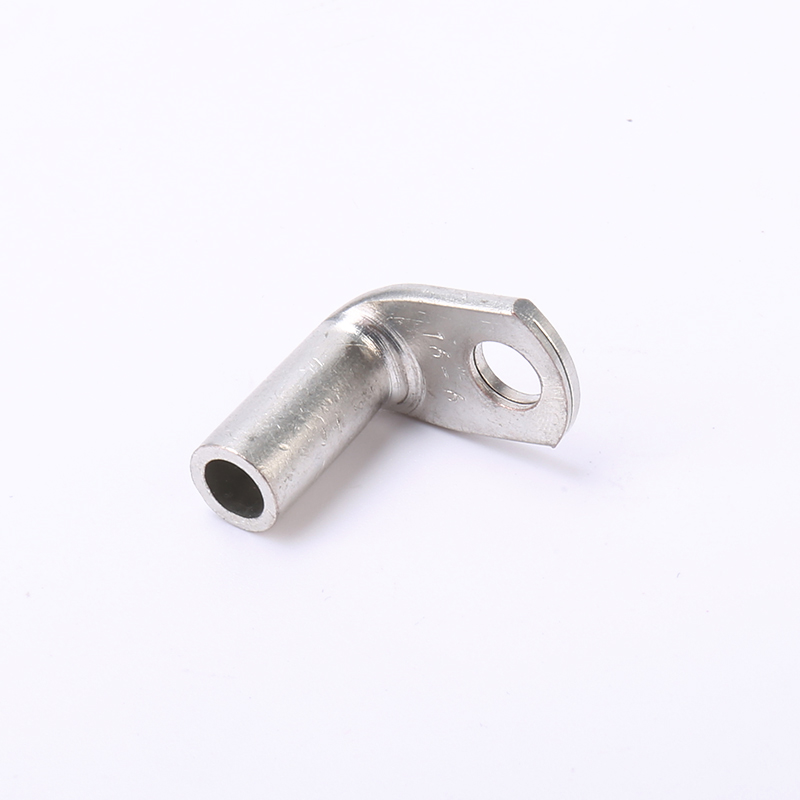
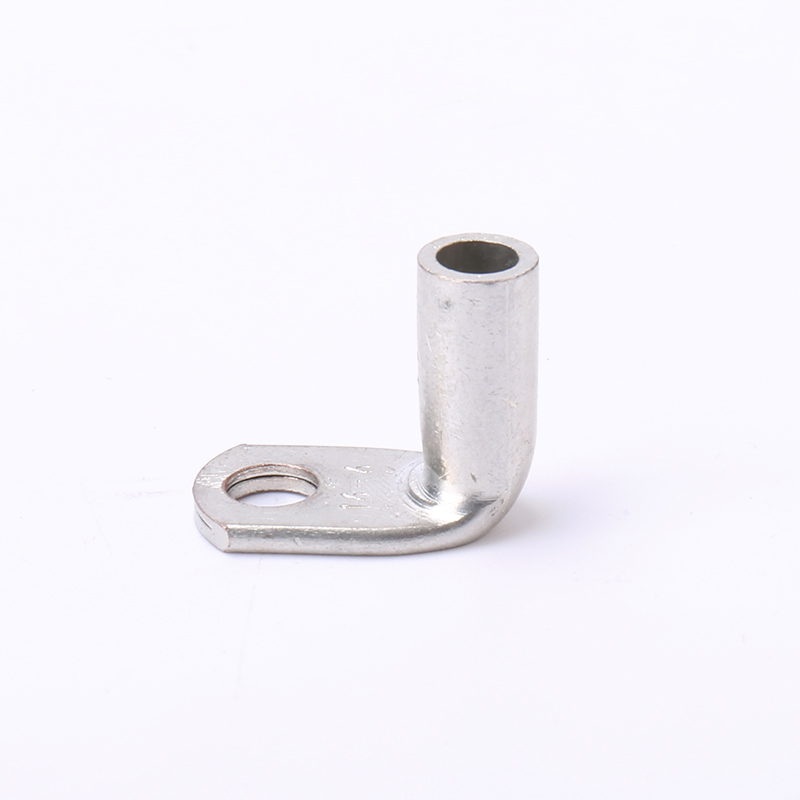
An angled copper cable lug (also called a right angle cable lug) turns the conductor exit by 90° so the cable leaves the stud perpendicular to the terminal face. A straight lug continues the cable in line with the stud. Both do the same electrical job, but they behave very differently once you close the enclosure door. This guide compares the two styles and gives you a practical four-step method to specify the correct one for tight enclosures.
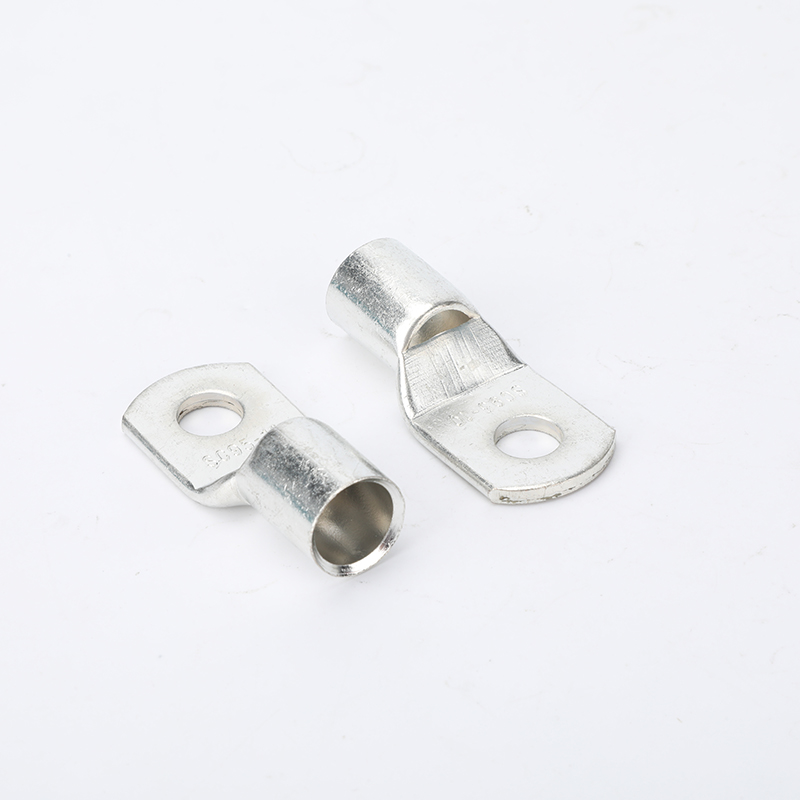
A straight DT copper cable lug is built from a tubular palm and an inline barrel: the cable enters one end and the stud hole sits on the same axis. A right angle cable lug forges or machines the palm so the barrel exits at 90° to the mounting face.
The bend is a formed part of the lug, not a joint, so it does not introduce a weak point when manufactured correctly. At ENVI ELEC we produce these from 99.9% pure, annealed copper (GB/T 5231 T2 / ENCW004A) for high conductivity and ductility, and the same material rules apply to both straight and angled versions. The only structural variable is geometry — everything else (conductivity, plating, stud sizing) stays identical.
This is where the two styles diverge most. A straight lug needs free linear space equal to its barrel length plus the cable’s minimum bend radius, measured in the direction the stud points. In a shallow compact distribution box, that straight run often collides with the enclosure wall or an adjacent device, forcing the installer to kink the cable.
A right angle cable lug removes that straight run. The cable exits sideways, so the limiting dimension becomes the much smaller perpendicular clearance. In panels where depth is the constraint, an angled lug is frequently the only way to achieve a clean, code-compliant bend. The image below shows an angled lug keeping the conductor clear inside a cramped box.
Tooling is essentially the same. Both lug types are fitted by crimping with a hydraulic or electric crimping tool using a die matched to the conductor cross-section, per IEC 61238-1 / GB/T 14315-2008. The difference is orientation discipline: a 90° lug must be rotated so its palm sits flush against the terminal before crimping, and the barrel must clear neighbouring parts after installation.
Access can actually improve with angled lugs in dense panels, because the cable routes away from the crowded “in-front” zone. The side-by-side view below illustrates how the two styles occupy space differently on the same rail.
Before selecting a lug, measure two clearances at the termination point: (a) the free depth from the stud face to the nearest obstruction, and (b) the side clearance perpendicular to the stud. Apply a simple rule: if the straight lug length plus roughly three times the cable diameter exceeds your free depth, choose a 90° lug. When side clearance is the only dimension available, a right angle cable lug almost always wins.
The lug barrel must match the conductor cross-section, and the palm hole must match the stud (bolt) size. Undersized barrels cause voids in the crimp; oversized holes let the lug spin and loosen. Use the quick reference below, then confirm against the full dimension table on the product page.
| Conductor (mm²) | Typical Stud (M) | Straight or 90°? |
|---|---|---|
| 10–25 | M6–M8 | Either (space-led) |
| 35–50 | M10 | Either (space-led) |
| 70–95 | M12 | Either (space-led) |
| 120–150 | M14 | Either (space-led) |
| 185–240 | M16 | Either (space-led) |
| 300–630 | M20 | Either (space-led) |
Values are a quick guide for standard ENVI DT/SC ranges (10–630 mm²). Always verify the exact stud hole and barrel dimensions on the product dimension table before ordering.
If the cross-section and material are the same, a 90° lug carries the same current as a straight one — the formed bend adds negligible resistance when properly manufactured. Stay within the lug’s continuous rating (ENVI DT lugs are rated 50 A–1200 A, operating from −55°C to 150°C). For distribution boxes in humid, coastal, or outdoor locations, specify a tinned copper cable lug; the tin plating slows corrosion at the palm and stud interface without changing ampacity.
The best lug fails if poorly terminated. Confirm: correct die for the conductor size, full compression with no cracks or burrs, specified bolt torque, strain relief so the cable is not pulling on the palm, and clear labelling. Where angled and straight lugs appear in the same enclosure, keep torque and torque-check procedures consistent so no termination becomes the weak link.
ENVI ELEC manufactures standard and custom beveled copper lugs in pure copper and tinned copper, 10–630 mm², built to IEC 61238-1. Send us your drawings for OEM/ODM angled lugs sized to your exact panel.
Does a 90° lug reduce current-carrying capacity?
No — not if it shares the same conductor cross-section, material, and plating as a straight lug. The 90° bend is a formed part of the lug, so it adds only negligible resistance. Current rating is governed by barrel cross-section and material (e.g., ENVI DT lugs: 50 A–1200 A), not by whether the exit is straight or angled. Always confirm the rating on the product’s dimension table.
Can 90° and straight lugs be mixed in the same circuit?
Yes, provided both lugs match in material, cross-section, and current rating, and are terminated to the same torque specification. Mixing is common when one termination is space-constrained and another is not. The key is consistency: same ampacity class and a uniform torque-check routine so neither joint becomes the failure point.
Is there a standard sizing chart for both types?
Yes. Lug sizing follows the conductor cross-section and stud size defined in IEC 61238-1 and GB/T 14315-2008 (with DIN 46234/46235 as common reference shapes). The stud hole maps to a metric bolt (M6–M20 across the 10–630 mm² range). ENVI publishes full dimension tables per catalogue number — see the quick reference in Step 2 above and the individual product pages for exact values.
When should I choose a 90-degree lug instead of a straight lug?
Choose a 90° lug whenever the free depth from the stud to the enclosure wall is too small for a straight lug plus the cable’s minimum bend radius. In shallow or densely packed compact distribution boxes, the angled exit is usually the only way to route the conductor without kinking it.
Are angled copper lugs suitable for outdoor or humid environments?
Yes. The bend geometry does not affect environmental resistance. For corrosive or high-humidity locations, specify tinned copper (such as the ENVI SC series) so the palm and stud interface resist oxidation. Bare copper angled lugs are fine for dry, indoor panels.
Can ENVI ELEC supply custom 90-degree / right-angle copper lugs?
Yes. As an OEM/ODM manufacturer with nearly 30 years in metal processing, ENVI produces custom beveled copper lugs and made-to-drawing angled lugs. Send your design drawings and we plan the tooling and production process.
What crimping tool do I need for angled copper lugs?
The same tooling as straight lugs: a hydraulic or electric crimping tool with a die matched to the conductor size, applied per IEC 61238-1. The only extra step is rotating the lug so the palm seats flush and the 90° barrel clears neighbouring components before crimping.
For compact distribution box wiring, the straight-versus-angled decision is really a space decision. Measure the clearance, match the cross-section and stud, confirm the current rating (use tinned copper in harsh environments), and terminate to spec. A right angle cable lug earns its place whenever depth is tight; a straight lug remains the simple default when room allows. Both deliver identical electrical performance when specified and installed correctly.
Request a Quote for Copper Cable Lugs
Tell us your conductor size, stud specification, and panel clearance. ENVI ELEC will recommend straight or angled copper lugs — or build a custom solution to your drawing.

With extensive experience, excellent craftsmanship, and superior customer service, we meet various technical requirements to satisfy our customers and have gained widespread