
Quick answer
A terminal lug supplier is only as good as the evidence it will put in writing. Before you approve a vendor, ask for four things: a mill certificate showing the copper grade, a dimensional report against your drawing, a third-party type-test report naming IEC 61238-1 or GB/T 14315, and a written lead time you can hold them to. Then verify the factory exists — by audit video, site visit or a live call from the production floor. Suppliers who satisfy all five are worth a long-term agreement. Suppliers who answer with a price list are a batch-consistency risk you will pay for later.
The cost of a bad lug batch is never the invoice. It is the rework, the missed shipment and the customer audit that follows.
For a B2B buyer, terminal lugs look like an easy category: low unit price, simple geometry, dozens of interchangeable suppliers on any sourcing platform. That apparent simplicity is exactly what makes the category dangerous. The parts arrive, they look right, they measure within a millimetre, and then six months later a customer reports hot joints on a panel that passed factory testing. The difference between a good batch and a bad one is rarely visible on arrival — it lives in copper grade, annealing, wall thickness and plating thickness, none of which you can assess with a tape measure.
This guide sets out what to check, in the order that filters out risk fastest, and what to walk away from.
Both can be legitimate partners, but they control different things, and that determines what they can promise you.
A manufacturer controls material purchase, tooling, forming, annealing, plating and inspection. Because it owns the process, it can change a dimension, adjust a plating thickness, hold a tolerance across batches and investigate a defect to its root cause. It can also tell you what it cannot do — which is more useful than a supplier who says yes to everything.
A trading company controls sourcing reach, consolidation, documentation and logistics. It can assemble a mixed container from six factories, handle export paperwork, and absorb small orders that a factory would refuse. What it cannot do is guarantee the process, because it does not run one. When a batch goes wrong, the trader’s answer is limited to “the factory says it is within tolerance”.
The trap is that many trading companies present as factories. The differentiation test is not what the website says. It is whether the entity that quotes you can describe its own annealing furnace, name the die sets it holds for your series, and produce a process audit for the line that will make your order.
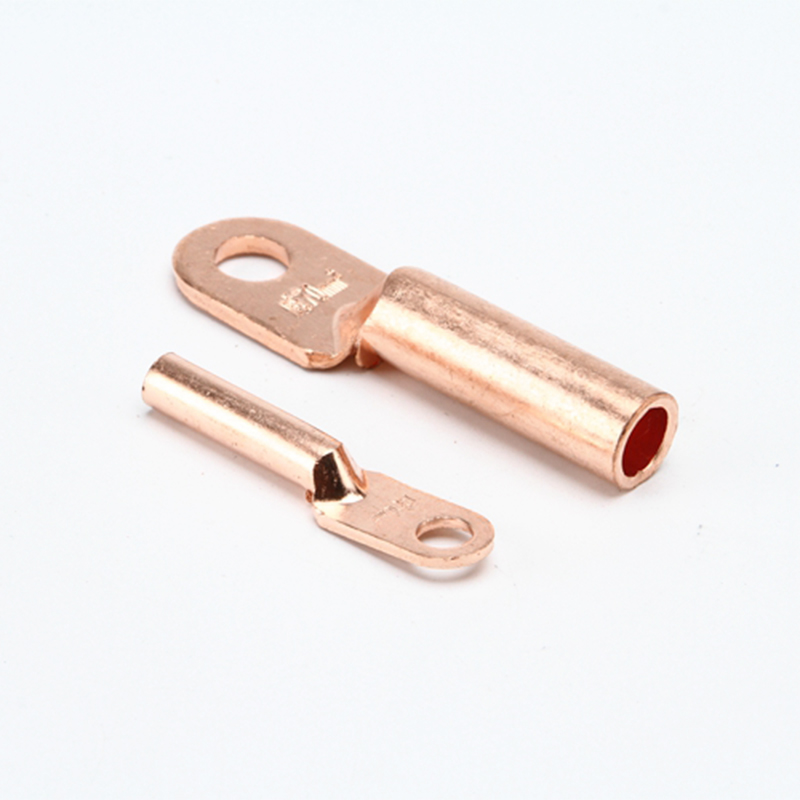
DT series copper terminal lugs 3 1
Four evidence categories separate a supplier you can design around from one you can only buy from once.
Ask for the mill certificate for the heat of copper used in your order, showing copper content and conductivity. For copper lugs the reference is T2 per GB/T 5231 at 99.90 % minimum, or C11000 for North American projects. A supplier who cannot produce a mill certificate is buying from the spot market, which means the grade in your next batch may not match the grade in this one.
Watch for the brass substitution. Brass machines faster and looks identical after plating, so it appears in low-cost parts sold as copper. Conductivity is the tell: brass runs at roughly a quarter of copper’s. A conductivity test on a sample settles the question in ten minutes.
Request a first-article inspection report against your drawing, with actual measured values — not tick boxes. The dimensions that matter most are barrel inner diameter (it decides whether the conductor enters and crimps correctly), barrel wall thickness (it decides current capacity and crimp integrity), palm thickness, bolt hole diameter and hole position. A supplier whose first article is within tolerance but whose sixth batch is not has a process control problem, not a measurement problem.
The question to ask is not “do you test?” but “what do you test, how often, and what happens when a result fails?” A credible answer includes in-process checks on barrel diameter and wall thickness, a plating thickness measurement method (X-ray fluorescence is standard), a crimp pull test on a sample per batch, and a documented non-conformance procedure with traceability to the batch. Our field guide to common defects in electrical hardware lists what those checks actually catch.
A serious supplier publishes current ratings with the test conditions attached: conductor size, ambient temperature, installation method, and the temperature-rise limit used. A single number in a catalogue with no conditions is not data, it is a marketing figure. If you are designing to a 70 K rise limit under IEC 61439, you need the supplier’s curve for that condition, not a headline ampacity.
Building a supplier shortlist?
Send us your drawing and annual volume. ENVI will return a quotation with material certificate, dimensional report and type-test reference attached — the same documents you would ask for in an audit.
Once the evidence checks out, four commercial criteria determine whether the relationship works after the first order.
Ask how the supplier handles a change of copper coil supplier or a tooling replacement, and whether they notify you. Batch-to-batch variation is the most expensive defect category in this product because it hides until assembly. The practical safeguard is a retained sample from each shipment, labelled with batch and date, kept until the project warranty expires.
Lead time is a promise only if it is broken down: raw material, production, plating, inspection, packing. A factory that quotes 25 days for a custom part should be able to say that 7 of those are plating and 3 are inspection. A single number with no breakdown is usually the optimistic case rather than the planning case.
MOQ should be negotiable in both directions. For standard series, a factory holding stock can ship small quantities; for custom tooling, the MOQ reflects the setup cost genuinely incurred. If a supplier’s MOQ drops dramatically when you mention a competitor’s price, the MOQ was never cost-based.
Custom palm geometry, non-standard stud spacing, laser marking with your part number, private-label packaging and mixed-model containers are the capabilities that turn a component supplier into a supply-chain partner. Ask specifically whether they cut their own tooling or outsource it, because tooling ownership decides how fast a design change can happen. The customized product range shows the kind of modifications that are routine, and the custom brass-aluminium bimetal cable lug is a typical example of a project-specific variant.
A warranty with defined terms — duration, what is covered, who pays freight on a claim — signals a supplier that has thought about failure. Vague reassurance signals the opposite. Ask for two references in your own segment, ideally at a similar current rating, and ask what went wrong in that project. Suppliers with real experience answer that question directly.
Three behaviours should end a supplier conversation regardless of price.
No third-party test report. In-house test data is better than nothing, but a type test to IEC 61238-1 or GB/T 14315 has to come from an accredited laboratory. A supplier who offers “our own report” for a type test is either misunderstanding the question or avoiding it.
Vague or shifting lead times. If the promised date moves twice before the order is placed, it will move after. Ask for the production schedule in writing and hold a deposit against it.
Refuses a factory audit. This is the clearest signal available. A supplier may legitimately decline a visit on scheduling grounds, but a flat refusal to allow any form of verification — site visit, video walkthrough, live call from the floor — means the entity quoting you is not the entity making the parts. A trading company is not a disqualification; a trading company pretending to be a factory is.
Established in 1995 and operating as Zhejiang Enwei Electric, ENVI has spent three decades doing one thing: metal processing for power fittings. That narrowness is the commercial argument. The company buys T2 copper and 1050/1350 aluminium as raw material, draws and forms it in-house, runs its own plating line, and inspects before packing. Nothing in the critical path is subcontracted, so a dimensional question gets an answer from the person who set the die.
In practice that means four things a buyer can use:
Traceability to the coil. Every batch carries the material certificate for the heat it came from, so a conductivity question can be answered rather than debated.
Tooling in-house. Custom palm shapes, stud spacing and marking are a tooling change, not an outsourcing project, which compresses the design loop from weeks to days.
Realistic MOQ. Because the standard series is held in stock, mixed orders across cable lugs, mechanical shear-bolt lugs and crimp terminals can ship together, which matters if you are consolidating a container.
Audit access. Site visits and live video walkthroughs of the production line are part of onboarding, not a favour. Buyers who take that option tend to stay for years, because the uncertainty is removed early.
None of that makes the company the right choice for every project. It does make the evaluation straightforward: the evidence is available before the order, not after the complaint.
Score each candidate out of 100 using the weights below. The point of the weighting is that commercial terms, which are easy to compare, count for less than process evidence, which is hard to fake.
| Criterion | Weight | Evidence to request |
|---|---|---|
| Material traceability | 20 | Mill certificate + conductivity test |
| Dimensional control | 20 | FAI report with measured values |
| Type-test evidence | 20 | IEC 61238-1 / GB/T 14315 report |
| Process & plating control | 15 | Plating thickness report, NCR procedure |
| Lead time reliability | 10 | Stage-by-stage schedule in writing |
| Customization capability | 10 | Tooling ownership, sample turnaround |
| Price & payment terms | 5 | Landed cost, not unit price |
Anything below 70 should not enter a framework agreement. Anything below 50 should not receive a first order, whatever the price.
Four checks: the business licence scope should include manufacturing rather than trading; the supplier should describe its own processes (drawing, annealing, plating, inspection) in specific terms; a live video walkthrough of the production line should be possible; and documentation should include a mill certificate and a type-test report. Any one of these alone can be faked; all four together are difficult to.
At minimum, ISO 9001 for quality management and a product type-test report against IEC 61238-1 or GB/T 14315 for the specific series you are buying. Depending on destination, add UL 486A-486B for North America, CE-related declarations for the EU, and RoHS material declarations. Certifications should name the product scope — a certificate that covers “metal products” generally tells you very little.
For standard series held in stock, yes — a factory can often ship a few thousand pieces or a mixed pallet. For custom tooling, MOQ reflects real setup cost and should not be expected to flex. The useful question is not “what is your MOQ” but “which part of the MOQ is setup and which is production”, because only the first is negotiable.
A manufacturer owns the production process and can therefore control and change material, dimensions, plating and inspection. A trading company owns sourcing and logistics relationships but not the process, so its ability to resolve a quality problem ends at the factory gate. Trading companies are useful for small mixed orders and for markets a factory does not serve directly; manufacturers are better when consistency and design change matter.
Vetting a terminal lug supplier is a documentation exercise, not a price comparison. Material certificate, dimensional report, type-test report, process control description and audit access — those five items answer 90 % of the questions that would otherwise surface eighteen months into the relationship. The red flags are equally simple: no third-party report, lead times that move, and a refusal to let anyone look at the factory.
Score the candidates, keep a retained sample from every shipment, and revisit the scorecard annually. A supplier relationship that is checked once at onboarding and never again is not managed — it is assumed.
Put the checklist to work
ENVI has supplied cable lugs and power fittings to utilities, panel builders and distributors since 1995. Ask for the full document pack — mill certificate, FAI report, type tests and factory audit — before you commit to a first order.
How to store copper terminal lugs to keep them like new
8 signs your cable lug connection is failing
Top 6 cable lug materials explained
Browse the cable lug range

With extensive experience, excellent craftsmanship, and superior customer service, we meet various technical requirements to satisfy our customers and have gained widespread