
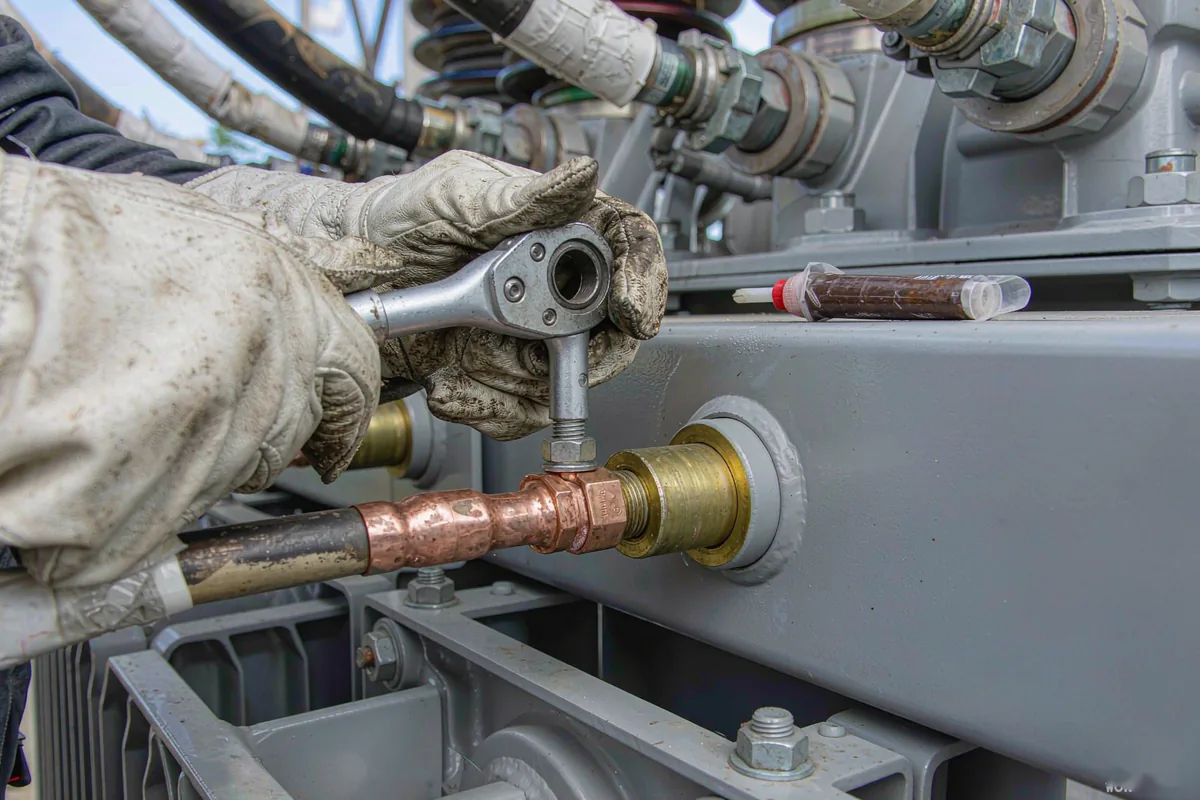
When you specify a cable lug, you are buying a connection that must stay tight for decades. Cable lug thermal cycling separates a reliable joint from one that quietly loosens in service. Every load cycle heats the conductor and the lug, then lets them cool, and each round changes contact pressure. You may not notice it at commissioning; you will notice it later as a hot spot or an unplanned outage.
This guide shows you what happens inside the joint, how IEC 61238-1 frames the heat cycle test and what to ask a supplier before you approve a lug.
A cable lug joint is a stack of different materials held together by mechanical force. Current flows through the barrel, the palm and the contact face of the busbar. When load rises, the joint heats; when load falls, it cools. The parts do not expand and contract at the same rate, so the contact interface is repeatedly sheared by a small amount. Over hundreds of cycles that movement changes the surface asperities that actually carry the current. You can think of thermal cycling as a slow fatigue test on the contact, not just on the metal.
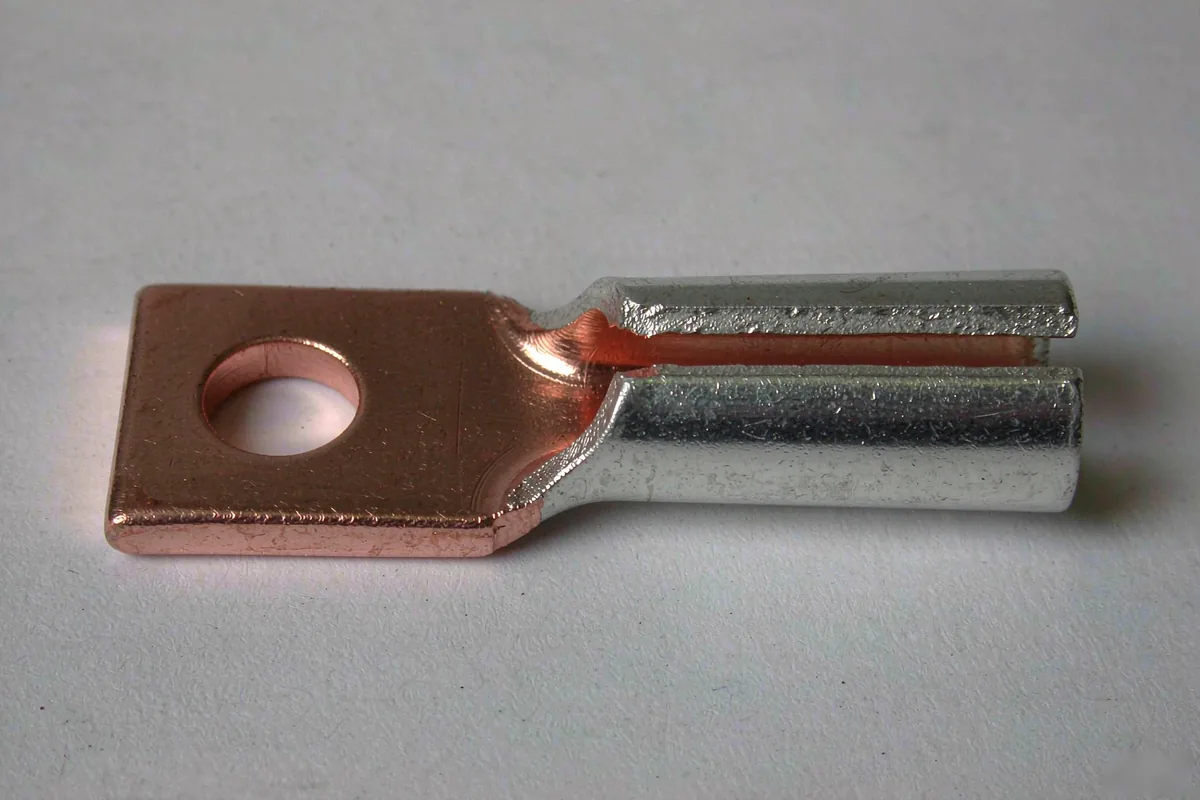
Aluminium expands roughly a third more than copper for the same temperature rise. In a bimetallic lug, the aluminium barrel and the copper palm are bonded, so the interface has to accommodate that difference on every cycle. In a bolted joint, the steel bolt, copper palm and aluminium busbar each move differently as well. You want a design that keeps the contact pressure inside a safe band across the whole temperature range, not only at 20 °C. Ask how the supplier’s barrel geometry and friction-weld bond handle that mismatch, and compare it with the DTL bimetallic copper-aluminium cable lug used for Cu/Al transitions.
Aluminium creeps under sustained pressure, especially when it is warm. Creep permanently deforms the conductor, while stress relaxation reduces the force the bolt can hold. Both effects lower contact pressure after the joint has been in service for a while. A joint that was torqued correctly at installation can therefore be under-clamped six months later. You should specify a lug and a fastener combination that has been evaluated after cycling, and consider spring washers, Belleville washers or shear-bolt designs where maintenance access is limited. Our mechanical (shear bolt) cable lugs are one option when you want a defined clamping force without a calibrated torque wrench on site.
Pure aluminium lugs on aluminium conductors avoid a galvanic interface, but aluminium’s higher expansion and creep rate make clamping-force retention more demanding. Copper lugs on copper conductors are more dimensionally stable. Bimetallic lugs sit between the two: they solve the Cu/Al transition while the aluminium barrel still needs correct crimping and support. The honest answer is that loosening depends more on joint design, surface preparation and installation quality than on the material name alone. You can study the friction-weld bond in the cross-section image below and review the wider cable lug range before you fix your specification.
You cannot see contact resistance on a visual inspection, which is why it is the most useful early indicator of a degrading joint. A tight, clean interface has low resistance. As the contact area shrinks or oxidises, resistance rises slowly, and the joint begins to generate more heat at the same current. That extra heat accelerates the next round of expansion, creep and oxidation. The loop is self-reinforcing, so a small drift at month three can become a visible hot spot by month eighteen. If you want a practical diagnostic routine, our guide on testing and troubleshooting heat generation in terminal lugs walks through the measurements.
Current only passes through the microscopic peaks of the two surfaces that are actually in contact. Reduce the clamping force and those peaks flatten less, so the real contact area falls. At the same time, exposed aluminium develops an oxide film that is far more resistive than the metal. Fretting from repeated expansion breaks that film and reforms it, adding another resistive layer. Measuring millivolt drop across the joint at a known test current gives you a repeatable number to trend, which is more useful than a single infrared snapshot.
Heat generated at the joint scales with the square of the current multiplied by resistance. Once resistance drifts upward, the local temperature rises above the conductor temperature, which widens the expansion mismatch and speeds up creep. You should treat a rising resistance trend as a maintenance trigger rather than waiting for a thermal camera to find a hot joint during a peak-load survey. Set an alert threshold in your commissioning records and compare like-for-like measurements taken at similar ambient temperatures.
IEC 61238-1 is the reference most buyers cite for compression and mechanical connectors on power cables. It is a comparative test: the connector is assembled on a reference conductor, subjected to a defined number of heat cycles, and its electrical behaviour is compared with the conductor itself. The point is not to prove that a lug never changes; it is to prove that any change stays within a controlled band. You should ask for the full report, not a certificate that simply says “compliant”.
A typical test loop heats the assembly to a specified conductor temperature, holds it, then cools it, and repeats for the required number of cycles. During the sequence the laboratory records connector temperature, resistance and the stability of the temperature curve. The commonly applied criteria look at the change in resistance relative to the reference conductor, the maximum temperature of the connector, and the behaviour of the resistance factor over the final cycles. Your acceptance specification should name the edition of the standard, the conductor class and size tested, the number of cycles and the exact limits used, because those details determine what “passed” actually means.
Start with the test sample description. A report covering one conductor size and one crimp die does not automatically qualify every size in the catalogue. Check whether the laboratory is independent, whether the report is dated, and whether the measured resistance values are shown as a table across cycles rather than a single final number. Look for the reference conductor data, the ambient conditions and any deviation notes. If a supplier can only offer a marketing summary, treat that as a gap in the evidence and request the raw data before you commit to a volume order.
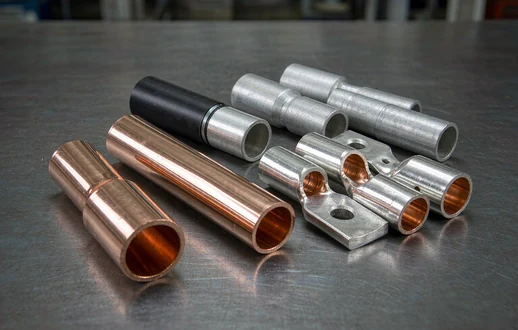
Compression lugs and bolted palms behave differently under thermal cycling. A crimped barrel relies on plastic deformation of the tube, while a bolted palm relies on stored elastic force in the fastener stack. Both can lose clamping force, but you verify them in different ways. Your specification should cover the torque value, the fastener grade, the washer arrangement, the surface finish of the palm and the re-torque policy, because each one changes how the joint ages.
A torque value without a surface condition is incomplete. Lubrication, plating and contact finish all change the relationship between applied torque and achieved clamping force. Ask the supplier for the recommended torque range for each palm and bolt size, plus any requirement for a flat washer or a spring element. For compact panels, the DTLX bimetallic small head lug shows how palm geometry affects the space available for a torque tool. Where you expect frequent temperature swings, specify a design with a documented resistance to loosening rather than relying on a higher torque value.
Re-torquing a hot joint can do more harm than good, because it disturbs the contact interface and may hide the underlying creep. You should define inspection intervals based on the duty cycle, take resistance or temperature trends at each visit, and only re-torque when the measured trend justifies it. Record the tool calibration, the torque applied and the person who signed the check so that your maintenance history can support an audit. For joints inside sealed switchgear, plan the access during a scheduled outage instead of an emergency call-out.
You will get a better result if you turn the discussion into a written checklist before you request quotes. The tool below is a static pre-purchase audit you can hand to your quality team. It will not replace type testing, but it will make supplier comparisons consistent and show you where evidence is missing.
| Check | What you verify | Pass criterion |
|---|---|---|
| Standard and edition | Named version of IEC 61238-1 and test scope | Report states edition, cycles and limits. |
| Sample coverage | Conductor sizes, classes and crimping tools tested | Your specified sizes are covered. |
| Resistance data | Resistance factor across all cycles | Stable trend with no upward drift. |
| Temperature behaviour | Connector temperature vs reference conductor | Connector stays within the agreed limit. |
| Joint hardware | Bolt grade, washers, plating and torque range | Documented and repeatable on site. |
| Traceability | Lab independence, date, batch and deviation notes | Full report available for review. |
Ask which sizes were actually tested, whether the report covers the exact crimping die you will use, what the maximum measured temperature rise was, how the resistance factor changed between the first and last cycles, what surface preparation the joint needs and how the recommended torque was established. You should also ask what happens when a batch changes material supplier. A manufacturer who can answer these questions with data is showing you the same discipline you will need during your own acceptance testing.
A cable lug is only one part of the connection. Its long-term performance also depends on conductor compatibility, crimping quality, contact pressure, and resistance to repeated thermal stress. A product that passes an initial inspection still needs to demonstrate consistent performance under the conditions it will face in service.
For BESS and other demanding electrical applications, test requirements should be part of the purchasing specification from the start. Rather than comparing suppliers by product price or a single pull-out value, look at the testing methods, actual results, and evidence behind their quality claims.
When evaluating cable lugs for your next project, explore ENVI’s copper and bimetallic terminal solutions and discuss your application requirements with our team. The right connection starts with the right specifications.
Need thermal cycling evidence with your quote?
Send ENVI your conductor size, material, duty cycle and applicable standard. You will get a matched lug recommendation plus the test and dimensional data your team needs to approve it.
Neither is universally better. A bimetallic lug removes the Cu/Al galvanic interface, but its aluminium barrel still creeps. Compare tested resistance stability for your exact size, not the material label.
Shear-bolt designs give a defined clamping force without a torque wrench, which helps consistency. Long-term retention still depends on the fastener stack, surface finish and the cycling profile.
Confirm conductor range, class and stranding, barrel length, palm hole pattern, plating, applicable standard and recommended crimp die. Check that the stated range includes your cable, not just a nominal size.
It depends on the standard class and connector type. Ask the supplier to state the cycle count and the resistance stability criteria used, then compare that with your expected service duty.
Tin mainly protects against oxidation and reduces contact resistance at assembly. It does not stop creep or expansion mismatch, so it complements rather than replaces a sound joint design.
Thermography is a useful screening tool, but it is load and emissivity dependent. Trended millivolt-drop or resistance measurements give you a more comparable number across site visits.
Testing and diagnostics
How to Test and Troubleshoot Heat Generation in Copper Terminal Lugs — a field measurement routine you can adopt.
Application reading
Bimetallic Lugs at Transformer Terminals — specs, standards and sizing for a cycling duty.
Product range
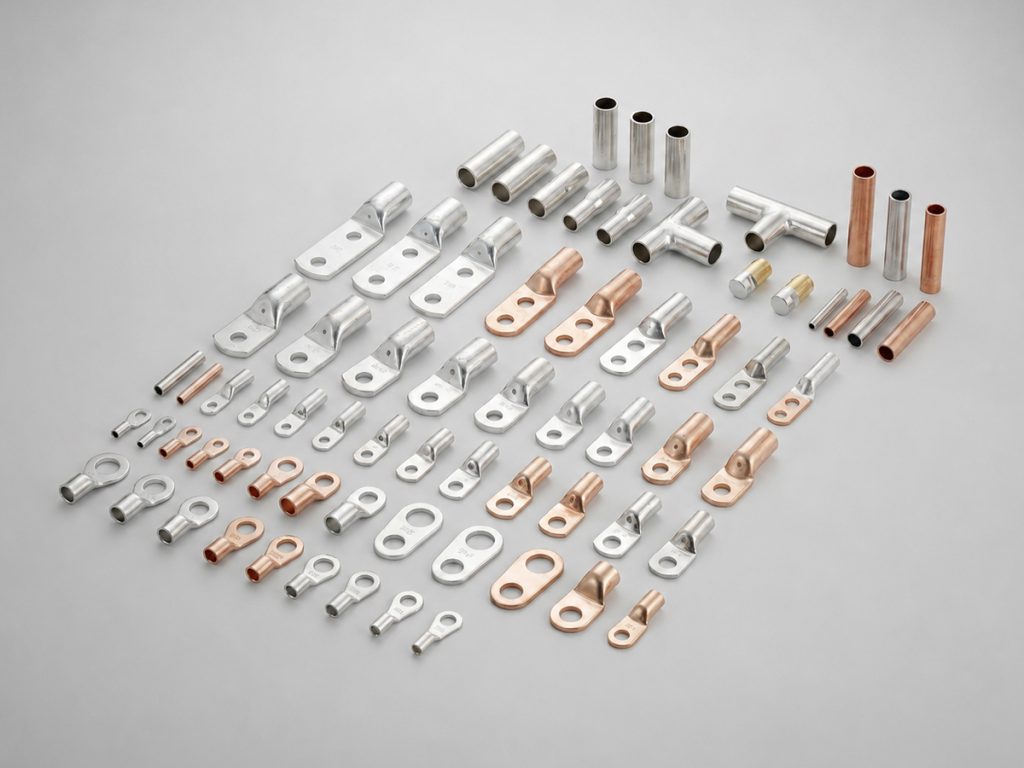
ENVI Cable Lug Catalogue — compare copper, aluminium and bimetallic options by size.

With extensive experience, excellent craftsmanship, and superior customer service, we meet various technical requirements to satisfy our customers and have gained widespread
 Optimized by Seraphinite Accelerator