

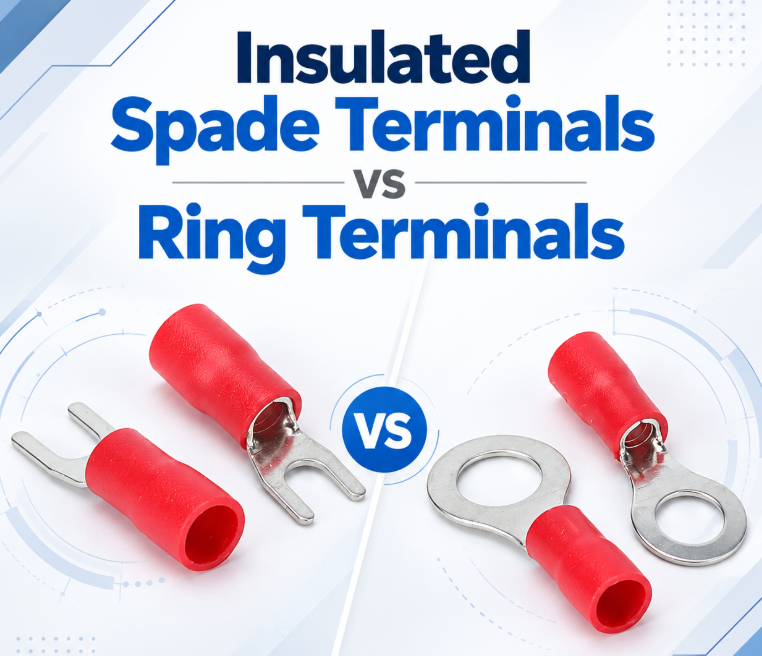
When you specify electrical connections for control panels, switchgear, or machinery, the small decision between an insulated spade terminal and an insulated ring terminal can ripple through your whole bill of materials—affecting installation time, vibration reliability, and rework cost across thousands of connection points. Both are pre-insulated, crimp-style terminals used to land a stranded or flexible conductor onto a stud or screw, but they behave very differently on the factory floor and in the field.
This guide is written for procurement managers, panel builders, and OEM engineers who buy terminals by the reel, not by the piece. We compare the two terminal types on the factors that actually move the needle for B2B buyers: connection security, installation and disconnection speed, wire gauge and current rating, material and plating options, and bulk sourcing economics. By the end you will have a practical checklist to specify the right terminal for your application.
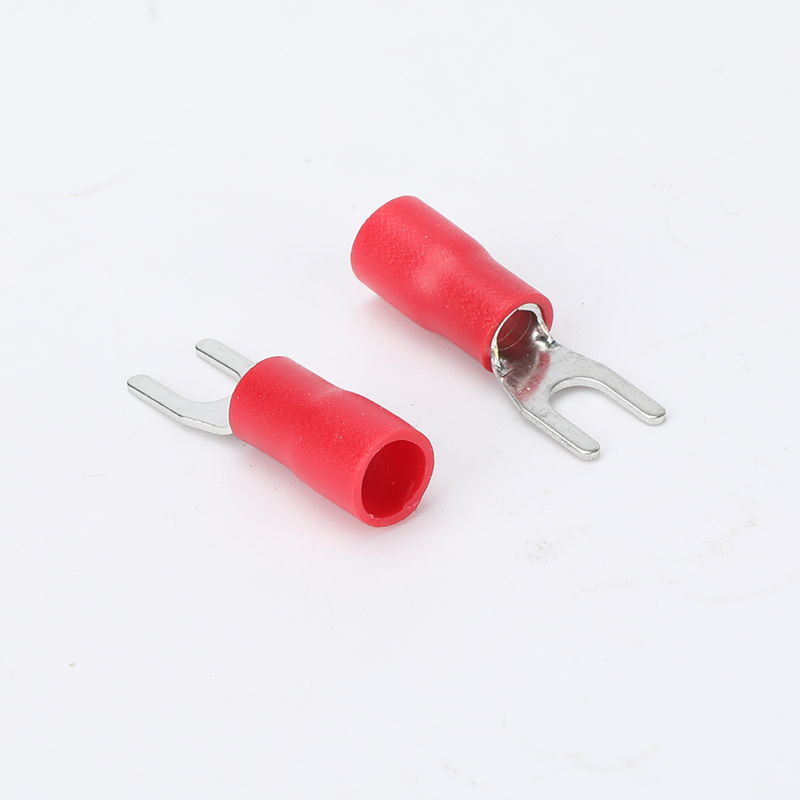
An insulated spade terminal (also called a fork terminal or spade lug) has a two-pronged, open “U” shaped tongue with a slot that slips sideways onto a stud or screw. The conductor is crimped into a barrel that is wrapped in a colour-coded PVC or nylon insulation sleeve. ENVI ELEC’s SV Series insulated spade terminals are produced from copper with tin plating and are rated to IEC 61984 / GB/T 13140.1, covering conductor cross-sections from 0.5 mm² up to 6 mm².
Because the tongue is open, a spade terminal can be mounted or removed without taking the stud completely out—you loosen the screw, slide the fork off, and slide the next one on. That makes it ideal for terminals that sit side-by-side on a busbar or for panels where several wires share one stud.
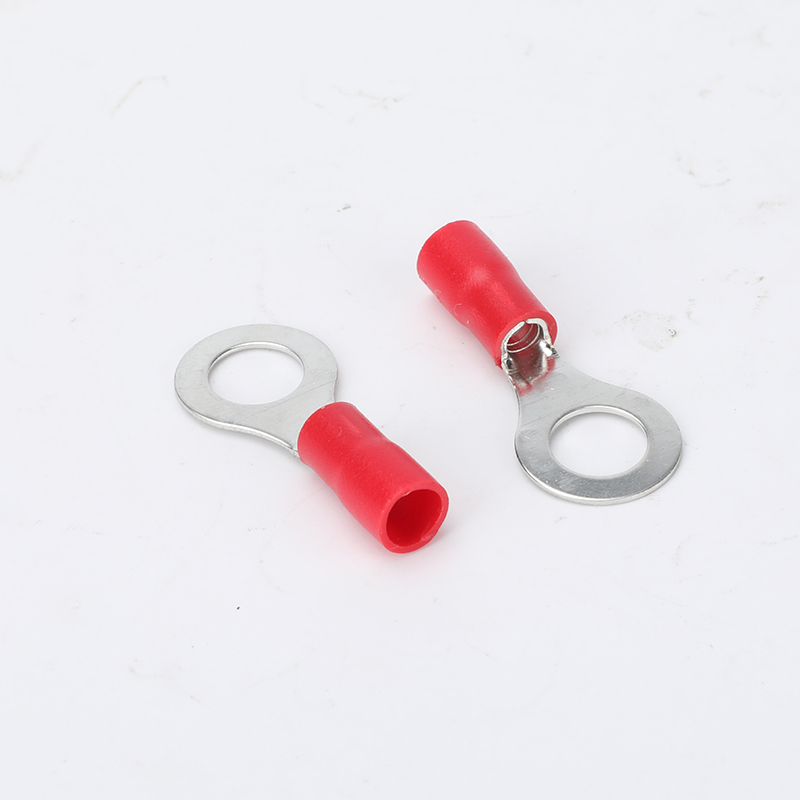
An insulated ring terminal (ring lug) has a closed, circular tongue with a hole that fits completely around the stud. Once the screw or nut is tightened, the ring is captured on all sides. ENVI ELEC’s RV Series insulated ring terminals use copper/brass with tin plating, a PVC sleeve, and the same IEC 61984 / GB/T 13140.1 reference standard, also spanning 0.5–6 mm² with a maximum rated current of about 27 A.
The closed loop is the key difference: a ring terminal cannot slide off the stud unless the fastener is fully removed. That is exactly what you want where vibration, shock, or thermal cycling could otherwise work a connection loose.
Ring terminals win on pure mechanical security. The fully enclosed tongue stays captured even if the screw backs off slightly, so it is the standard choice for vibrating environments—control cabinets on moving machinery, HVAC units, and vehicle electrical systems. Spade terminals rely on the screw head holding the fork in place; under heavy vibration a partially loosened screw can let the fork walk off. For static panels where screws are torqued once and left, spades are perfectly secure.
Spade terminals are faster to install and replace. Because the tongue is open, you do not need to remove the nut or stud—just slacken the screw and fork the terminal on or off. In high-mix panel assembly or during maintenance where one wire of many must be swapped, that saves real labour. Ring terminals require full removal of the fastener, which is slower but gives a more positive lock.
For both families the insulation colour follows the standard DIN/UL scale: red (0.5–1.5 mm²), blue (1.5–4 mm²), yellow (4–6 mm²). As a rule, do not crimp a conductor outside the rated cross-section range or you risk a cold, high-resistance joint. For the SV and RV series the maximum rated current is around 27 A; heavier feeders should move up to cable lugs rather than pre-insulated terminals.
Copper or brass barrel with tin plating is the default for corrosion resistance and solderability. PVC insulation is common for general indoor use; nylon (often rated higher temperature) suits harsher duty. When specifying, match the plating to the mating surface—tin-to-tin is the safe, low-cost pairing for most B2B orders.
Per piece, spade and ring terminals in the same series cost almost the same. The real B2B saving is in assembly labour and rework: spades cut installation time where frequent changes happen; rings cut warranty claims where vibration failures occur. Buying by the reel from a single OEM/ODM source also lets you standardise the insulation colour system across your whole product range.
Use this quick decision rule:
Need the full range on one spec sheet? Browse the ENVI ELEC full product range for pre-insulated terminals, cable lugs, and custom OEM/ODM options.
Specifying terminals for your next panel build?
ENVI ELEC supplies SV and RV series insulated terminals with IEC/GB compliance, tin plating, and OEM/ODM customisation. Request samples and a volume quote for your exact cross-section mix.
A spade (fork) terminal has an open tongue that slides onto a stud without removing the screw; a ring terminal has a closed loop that must be fully seated under the fastener. Rings lock more securely; spades install and swap faster.
For high-vibration or shock-loaded industrial wiring, yes—the closed loop cannot slip off a partially loosened screw. In static, low-vibration panels, a properly torqued spade is equally reliable and faster to service.
Only if the stud and current rating match. They are not mechanically interchangeable in the same joint: a spade can fall off if the screw loosens, while a ring stays captured. Pick based on vibration and service needs, not convenience.
Ring terminals. The enclosed tongue remains secured as long as the fastener holds any clamping force, making them the safer choice on moving equipment and vehicles.
Typical pre-insulated SV/RV terminals cover 0.5–6 mm² (red/blue/yellow sleeves), up to about 27 A. Larger feeders should use bimetal or copper cable lugs instead.
Neither terminal is “better” in the abstract—ring terminals maximise lock security under vibration, while spade terminals maximise speed where connections are serviced often. The right B2B choice is application-driven and, just as important, sourced from a supplier that holds IEC/GB standards, plates consistently, and can deliver reels of mixed sizes on one PO. ENVI ELEC’s SV and RV series give you both options from a single, audit-ready source.
Ready to standardise your terminal sourcing?
Talk to our engineering team for a cross-section recommendation, free samples, and OEM/ODM tooling for your branded terminals.

With extensive experience, excellent craftsmanship, and superior customer service, we meet various technical requirements to satisfy our customers and have gained widespread
 Optimized by Seraphinite Accelerator