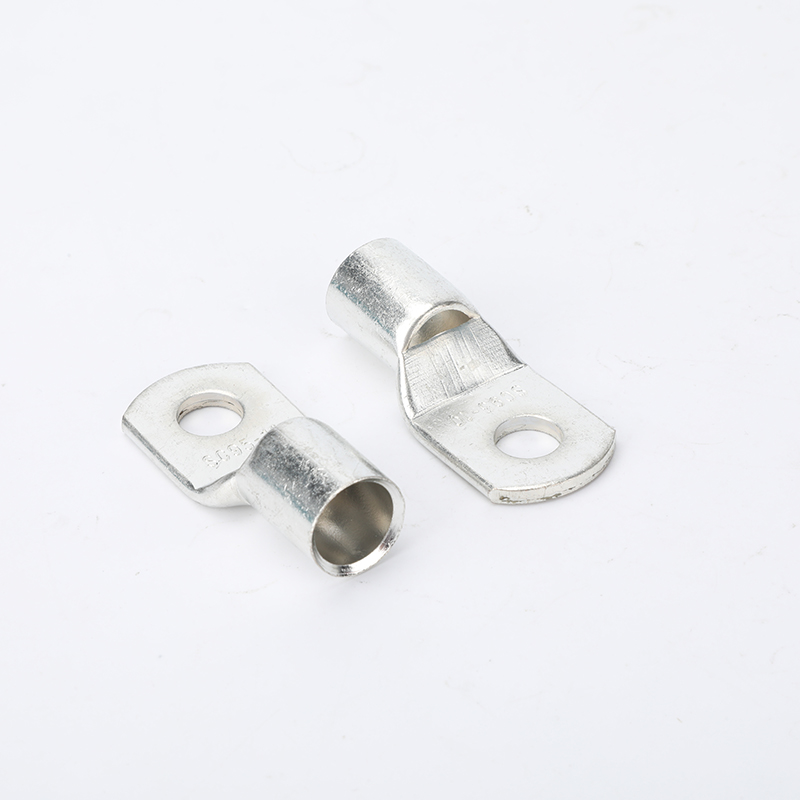



Choosing between narrow tongue and standard copper lugs for MCCBs doesn‘t have to be complicated. The wrong choice can lead to dangerous clearance violations or failed terminations. This guide contrasts narrow tongue lugs for molded case circuit breakers with standard compression lugs, covering space constraints, current ratings, and application-specific requirements to help you make the right decision with confidence.
When terminating large conductors onto molded case circuit breakers, space is often the most limiting factor. MCCB terminals are typically positioned close together to minimize panel footprint, with terminal spacing commonly around 50–60 mm for standard power distribution applications. A standard copper lug with a wide palm simply may not fit between adjacent terminals. Worse, forcing an oversized lug into a tight space can create dangerous clearance violations that compromise electrical safety. Understanding the difference between narrow tongue and standard copper lugs is essential for code‑compliant, reliable terminations.

| Aspect | Standard Copper Lug | Narrow Tongue Copper Lug |
|---|---|---|
| Tongue width | Wide (typically 0.55″ to 1.7″) – | Narrow (e.g., 0.4″ on some LCAN series) – |
| Best application | Busbars, general switchgear, unrestricted access | MCCBs, motor starters, safety switches, compact panels |
| Primary advantage | Maximum contact area, excellent heat dissipation | Fits tight terminal spacing, prevents clearance violations |
| Current rating | Suitable for very high currents (does not sacrifice ampacity) | Same ampacity as standard lugs for the same wire size |
| Barrel design | Standard bell mouth or flared entry | Same barrel dimensions as standard lugs, often with inspection window |
| Installation | Requires adequate panel space | Engineered for confined MCCB compartments |
The most visible difference between standard and narrow tongue copper lugs is the width of the tongue (or palm). A standard copper lug features a wide tongue, typically ranging from 0.55″ up to 1.7″ depending on the conductor size. In contrast, a narrow tongue copper lug has a significantly reduced width – for example, 0.4″ on some LCAN series lugs. This reduction is precisely what allows narrow tongue lugs to fit between closely spaced MCCB terminals without contacting adjacent hardware.
Standard copper lugs are best suited for busbars, general switchgear, and applications where terminal access is unrestricted and spacing is generous. Narrow tongue copper lugs, on the other hand, are specifically engineered for molded case circuit breakers (MCCBs), motor starters, safety switches, and compact power panels where terminal pitch is tight and a standard lug would create interference or clearance issues.
The primary advantage of a standard copper lug is its maximum contact area, which delivers excellent heat dissipation and mechanical stability under vibration. The primary advantage of a narrow tongue copper lug is that it fits into tight terminal spacing while preventing dangerous clearance violations – phase‑to‑phase or phase‑to‑ground – that could compromise safety and code compliance.
A standard copper lug is suitable for very high continuous currents and does not sacrifice ampacity even at larger wire sizes. A narrow tongue copper lug carries the same ampacity as a standard lug for the same wire size. Because the barrel dimensions (which determine current capacity) remain unchanged, reducing the tongue width does not lower the current rating.
Standard copper lugs typically feature a bell‑mouth or flared barrel entry to facilitate easy insertion of stranded conductors. Narrow tongue copper lugs share the same barrel dimensions as standard lugs – ensuring identical wire range and crimp tool compatibility – but they often include an additional feature: an inspection window. This small opening allows visual confirmation that the conductor is fully seated before crimping, significantly reducing termination failures.
Installing a standard copper lug requires adequate panel space and unrestricted access around the terminal; if two standard lugs are placed on adjacent MCCB studs, they may contact each other or violate minimum clearance distances. Narrow tongue copper lugs are specifically engineered for confined MCCB compartments. Their narrow profile allows proper torque tool access and ensures that NEMA and IEC creepage and clearance distances are maintained, even in densely packed panels.
The most straightforward way to decide is to measure the center‑to‑center distance between adjacent terminal studs on your circuit breaker. Standard MCCB terminal spacing often falls around 50–60 mm. If the terminal barrier width or inter‑phase spacing is less than the width of your standard lug tongue, a narrow tongue lug is the correct solution. Always consult the MCCB manufacturer‘s data sheet for exact terminal dimensions.
Both standard and narrow tongue lugs are available across the full range of common conductor sizes. The barrel dimensions on narrow tongue lugs are identical to those on standard lugs of the same wire gauge. For MCCB applications, typical conductor sizes range from #8 AWG up to 500 kcmil or 300 mm² . Always match the lug barrel to the exact conductor gauge—do not cut strands to force a cable into a smaller lug.
For clean, dry indoor switchrooms: Standard copper lugs with bare copper finish may be acceptable.
For industrial panels, outdoor enclosures, or marine environments: Select tin‑plated narrow tongue lugs. The tin coating dramatically enhances corrosion resistance and maintains low contact resistance over decades of service.
For high‑temperature environments (up to 155°C or 311°F): Ensure the lug‘s material and plating are rated accordingly.
For installations requiring third‑party validation, verify that your narrow tongue lugs meet recognized standards. IEC 61238‑1 is the international benchmark for compression and mechanical connectors for power cables, covering mechanical strength, electrical continuity, and thermal cycle performance. GB/T 14315‑2008 (the Chinese national standard for copper terminals) applies for projects following Chinese electrical codes. Always verify that your lugs comply with the applicable standard for your jurisdiction.
Most MCCB terminations use single‑hole lugs, but double‑hole narrow tongue lugs are also available for applications requiring greater rotational stability. Double‑hole configurations prevent the lug from rotating on the stud over time, which is particularly important in high‑vibration environments.
At Envi Electric, we understand that MCCB terminations require precision, not guesswork. Our range of narrow tongue copper lugs is manufactured to meet the demands of modern power distribution applications, with features including inspection windows, bell‑mouth barrel entries for easy conductor insertion, and tin‑plated corrosion protection. Explore our full lineup of compression lugs, mechanical lugs, and copper terminals at Our Web.
What is a narrow tongue copper lug for MCCB applications?
A narrow tongue lug has a reduced palm width compared to standard lugs, specifically designed to fit into the tight terminal spacing found on molded case circuit breakers while maintaining full electrical performance.
Can I use a standard copper lug on an MCCB if I have enough panel space?
Space on the panel is not the constraint—terminal spacing on the breaker itself is. If your standard lug‘s tongue width exceeds the available clearance between adjacent MCCB terminals, it should not be used regardless of panel space.
Do narrow tongue lugs sacrifice current rating compared to standard lugs?
No. For the same conductor size, a correctly manufactured narrow tongue lug carries the same ampacity as a standard lug. The barrel design—which determines current capacity—remains unchanged; only the tongue width is reduced.
Does Envi Electric offer narrow tongue copper lugs with international standard compliance?
Yes. Our narrow tongue copper lugs are manufactured in accordance with IEC 61238‑1 and GB/T 14315‑2008, and we offer tin‑plated versions for demanding environments. Visit Our Web to browse our full product range.
The choice between narrow tongue and standard copper lugs for MCCBs is clear. Use standard copper lugs for unrestricted busbars and open switchgear where terminal spacing is generous. Choose narrow tongue copper lugs specifically when terminating onto molded case circuit breakers, motor starters, safety switches, or any panel component with confined terminal spacing. When in doubt, measure your terminal spacing first—then match the lug tongue width to the gap, not the other way around.
For reliable narrow tongue copper lugs that meet IEC 61238‑1 and GB/T 14315‑2008 standards, trust Envi Electric. Visit Our Web today to explore our full range of copper compression lugs, request a quote, or speak with our technical team about your specific MCCB termination requirements.

With extensive experience, excellent craftsmanship, and superior customer service, we meet various technical requirements to satisfy our customers and have gained widespread
 Optimized by Seraphinite Accelerator