
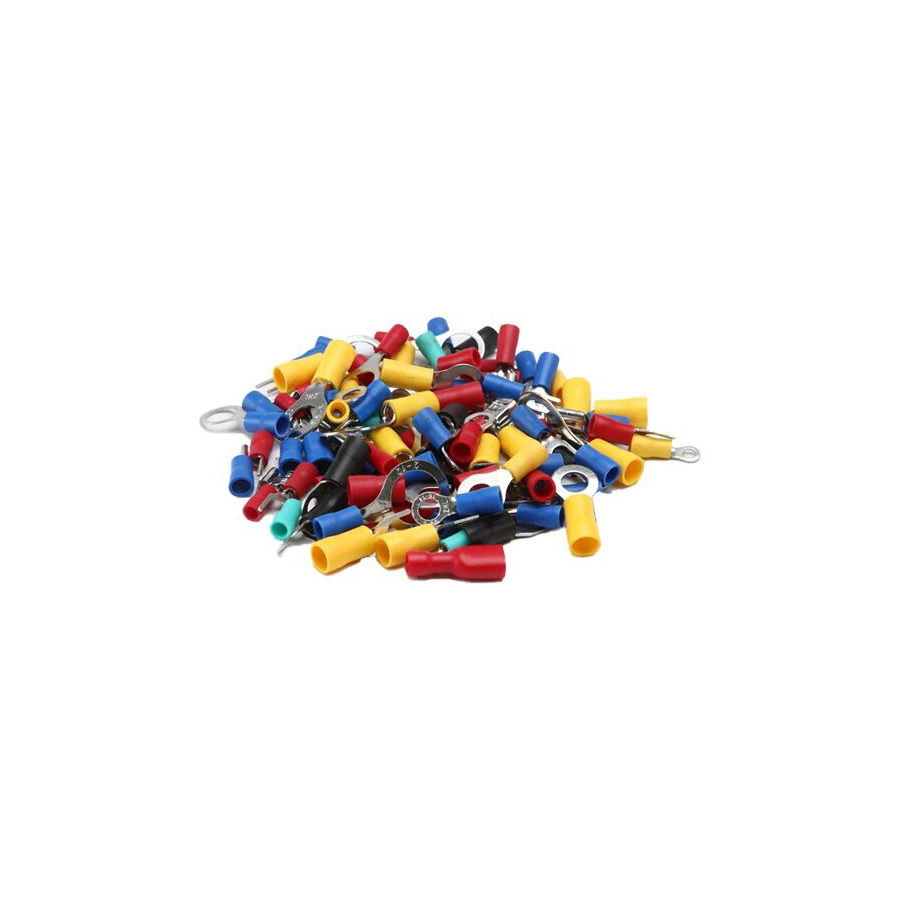
Many friends new to the electrical industry, or those purchasing cold-pressed terminals for the first time, encounter a common problem: with so many models of pre-insulated cold-pressed terminals, what exactly are the differences? How should one choose?
Common pre-insulated cold-pressed terminals on the market include dozens of specifications such as pin, tubular, ring, fork, and blade types. If selected incorrectly, it not only affects installation efficiency but may also lead to poor contact, overheating, or even equipment failure.
This article will help you quickly understand the uses of different types of pre-insulated cold-pressed terminals from three aspects: classification, characteristics, and application scenarios.
Cold-pressed terminals are connection devices that do not require welding; they use a dedicated crimping tool to apply mechanical pressure, causing the plastic deformation of a metal sleeve to clamp the wire tightly. Compared with welding, cold-pressed connections have the following advantages:
Fast installation speed;Stable conductive performance;Strong vibration resistance;No need for soldering or high-temperature operations; Convenient maintenance and replacement.
“Pre-insulated” means that when the terminal leaves the factory, an insulation sheath (usually made of PVC or nylon) is already fitted over the outside of the metal tube. This sheath not only serves as electrical insulation but also protects the crimped area from the effects of vibration, moisture, and corrosion, making it much more efficient than sliding a heat-shrink tube over a bare terminal.
Therefore, pre-insulated cold-pressed terminals are widely used in fields such as power distribution cabinets, electrical control cabinets, industrial automation, new energy, power equipment, rail transit, communication equipment, and household appliances.
Although pre-insulated terminals on the market come in various shapes, their core can be divided into the following four categories:
3.1 Tubular Terminals (VE Type / TE Type)
The most commonly used, bar none.
Appearance: A cylindrical metal tube with a plastic sheath. Its original design intention is to protect multi-strand flexible wires and prevent the wire ends from spreading out.
Standard Type (VE Series): Standard length metal tube, with the sheath color corresponding to the wire diameter.
Twin-wire Tubular Terminal (TE Series): The inner diameter of the metal tube is larger, specifically used for simultaneously crimping two wires of the same or different cross-sectional areas, making it very practical for equipotential bonding and branch distribution.
Applicable Scenarios: It is practically a standard component for all European standard electrical cabinets. Used in PLC control cabinets, inverter wiring, the load side of air switches, and intermediate relay bases. As long as multi-strand flexible wires are connected to screw-crimped terminals or cage spring terminals, these must be used.
3.2 Head-type Terminals (RV / SV / PTV / DBV)
The head of this type of terminal features a flat metal structure intended to be locked tightly by a screw.
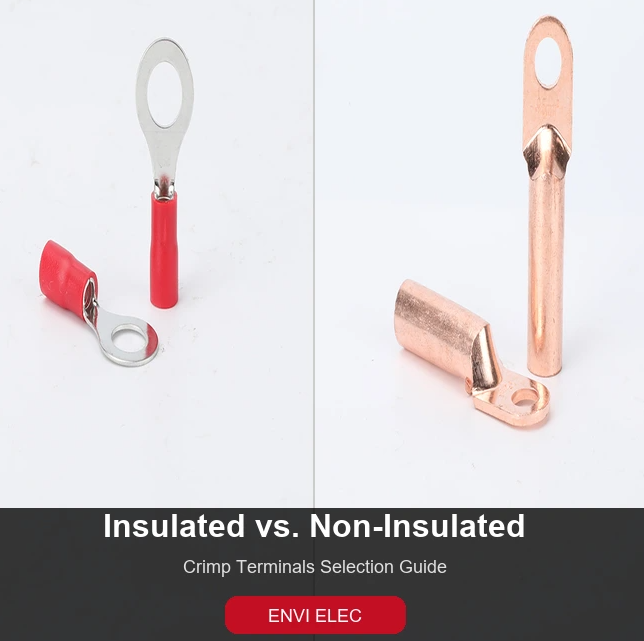
Ring Type (RV Series): The head is a closed ring.
Applicable Scenarios: The most secure screw-fixing scenario, suitable for high-current and strong-vibration environments, such as ground busbar connections, motor terminal boxes, and transformer terminals. The downside is that the screw must be completely removed for installation.
Fork / U-Type (SV Series): The head looks like a tuning fork, featuring an open design.
Applicable Scenarios: Switch buttons, indicator lights, relay bases, and other places that require frequent disassembly but where you don’t want to completely unscrew the screw. It boasts high maintenance efficiency, but its vibration resistance is slightly inferior to the ring type.
Pin Type (PTV Series): The head is a solid cylindrical pin, similar to the pin section of a tubular terminal, but usually used for direct mating with plug-in terminal blocks.
Blade Type (DBV Series): The head is a flat metal blade.
Applicable Scenarios: Extremely narrow wiring spaces, or older flat-structured terminal blocks.
3.3 Quick Connect Male/Female Terminals (MDD / FDD / MPD / FRD)
The biggest advantage of this type of terminal is that it allows for “quick plugging and unplugging.”
Quick Disconnect Type (MDD / FDD Series): Blade-like quick connect.
Applicable Scenarios: Widely used in places that require frequent maintenance and disassembly, such as internal wiring of household appliances and automotive relays.
Bullet Type (MPD / FRD Series): Male and female mating structure, shaped like a bullet.
Applicable Scenarios: Internal wiring of modular equipment requiring quick plugging and unplugging, such as electric vehicle controller wiring harnesses and car audio modifications. It supports blind mating and features good foolproof properties.
3.4 Insulation Sheath Classification: PVC & Nylon
This is a detail that many people easily overlook, but choosing the wrong one can cause major problems.
PVC Sheath: The most common, with colors representing the wire diameter (primarily red, blue, and yellow). The temperature resistance range is usually -10°C to 75°C.
Applicable Scenarios: Ordinary indoor environments and inside distribution boxes. High-end versions will use semi-rigid PVC, which is less likely to crack during crimping.
Nylon Sheath: Translucent, bright surface, and features an extremely tough texture. Temperature resistance can reach -40°C to 105°C or even higher, and it is resistant to oil, acids, and alkalis.
Applicable Scenarios: Harsh environments involving alternating high and low temperatures or oil pollution, such as outdoor charging stations, photovoltaic inverters, ships, and high-speed rail. Dedicated tools are required for crimping; ordinary pliers cannot crimp them tightly.
When purchasing or using cold-pressed terminals, never look solely at the price; the material is the core factor that determines safety:
4.1 Look for High-purity Copper (T1/T2): Inferior terminals will use brass or even sheet iron to save costs. Truly high-quality terminals should be made of high-purity copper, which has extremely high conductivity and a relatively soft texture, making it less prone to cracking during crimping.
4.2 Tin-plating Process: Good copper terminals will have a uniform tin-plated layer (silvery-white) on the surface; this is not only for aesthetics but, more importantly, to prevent the copper from oxidizing and blackening in the air, ensuring low contact resistance for over a decade or even decades.
4.3 Insulation Sleeve Flame Retardancy: High-quality insulation sleeves (PVC or nylon material) should not only have bright colors to facilitate distinguishing the wire diameter, but should also possess good flame retardant properties, preventing the spread of flames if exposed to fire.
4.4 Summary Table: To facilitate your procurement and verification, the core selection logic is summarized below:
| Terminal Type | Common Series Code | Front-end Shape Features | Typical Applicable Scenarios |
| Tubular Terminals | VE, TE(Twin-wire) | Hollow metal cylinder | Air switches, contactors, PLCs, cage spring terminals |
| Ring Terminals | RV | Closed ring | Ground busbars, motor terminal boxes, screw fixing in strong-vibration environments |
| Fork Terminals | SV | Open U-shape / tuning fork shape | Button switches, relay bases, screws requiring quick disassembly |
| Blade Terminals | DBV | Flat metal blade | Narrow wiring spaces, flat terminal blocks |
| Pin Terminals | PTV | Solid cylindrical pin | Plug-in terminal blocks, deep hole wiring |
| Quick Disconnect Blade | MDD (Male) / FDD (Female) | Blade-like quick connect | Household appliance internal wiring, automotive relays |
| Quick Disconnect Bullet | MPD (Male) / FRD (Female) | Bullet-head male and female mating | Automotive wire harnesses, modular circuits, frequent quick plugging and unplugging |
Although pre-insulated cold-pressed terminals are small auxiliary materials, the crimping quality directly determines the temperature rise and lifespan of the circuit.
Never use standard pliers to crimp terminals!
Different terminals require corresponding dedicated crimping pliers. Terminals that have been flattened by standard pliers have an extremely small contact area and are prone to loosening, which can lead to tripping in mild cases, or overheating and catching fire in severe cases. If you encounter nylon-sheathed terminals, you must use dedicated ratchet-style pliers to ensure that the insulation layer is not damaged and that the metal tube undergoes a perfect geometric deformation.

With extensive experience, excellent craftsmanship, and superior customer service, we meet various technical requirements to satisfy our customers and have gained widespread
 Optimized by Seraphinite Accelerator