
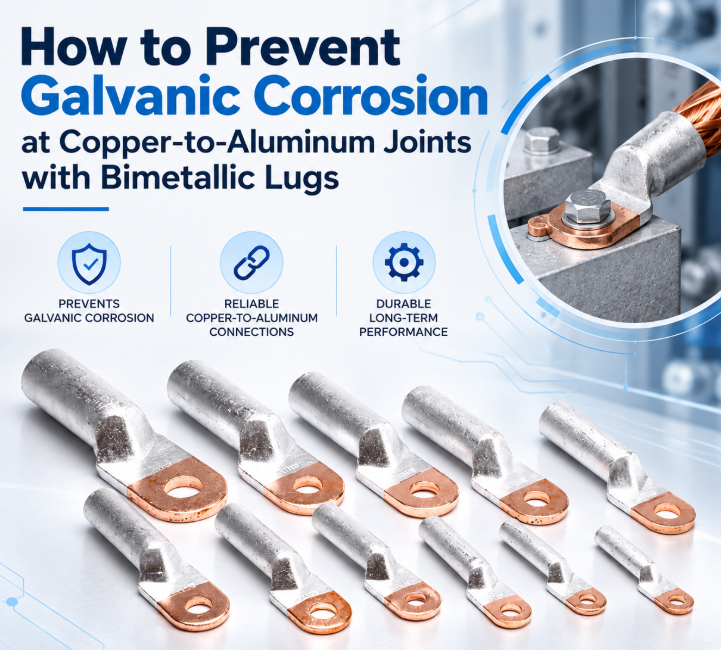
Galvanic corrosion at copper-to-aluminium joints is one of the most common, and most preventable, causes of overheating and failure in power distribution. Aluminium and copper sit far apart in the galvanic series; put them in contact with moisture and an electrolyte, and the aluminium sacrifices itself—the joint loosens, resistance climbs, and the connection runs hot. The standard defence is the bimetallic (Cu/Al) lug, which removes the dissimilar-metal contact by design.
This guide goes beyond “use a bimetal lug” to the installation discipline that actually keeps the joint alive for decades: correct sizing to IEC/GB, surface preparation, anti-oxidant application, crimp torque, sealing, and inspection—plus the five mistakes that let corrosion come back.
Galvanic corrosion needs three things: two dissimilar metals, an electrical path between them, and an electrolyte (water, condensation, salt, or pollution). Aluminium is anodic to copper, so in that couple aluminium oxidises and loses mass. The oxide layer is poorly conductive, so contact resistance rises; the joint heats; thermal cycling loosens the fastener; and the loop accelerates. Even a “clean” Al-to-Cu bolted joint will corrode once humidity enters, which is why field Al-Cu joints are avoided in favour of bimetallic lugs.
A bimetallic lug is a single body with an aluminium barrel friction-welded to a copper palm. The aluminium conductor is crimped into the aluminium barrel (Al-to-Al), and the copper palm is bolted to the copper busbar or equipment (Cu-to-Cu). The dissimilar metals never touch in the field, so there is no galvanic couple at the termination. ENVI ELEC’s DTL bimetal lug is manufactured to IEC 61238-1 / GB/T 14315; the DTLX bimetallic small-head lug provides the same protection where space is tight. The weld itself is the corrosion barrier—so its quality (no delamination, no porosity) is what you are really buying.
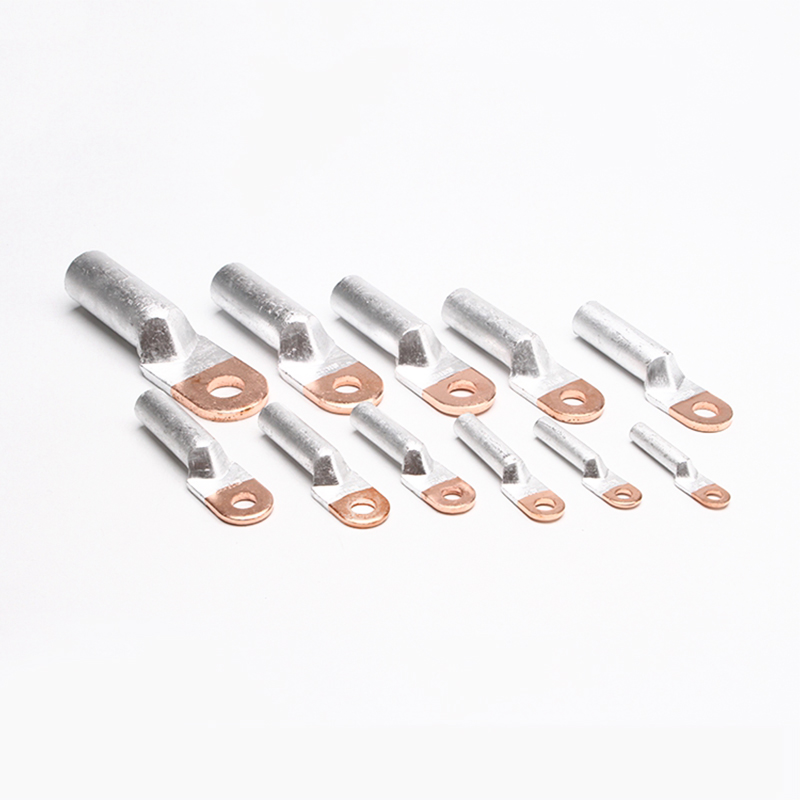
Match the lug barrel to the conductor cross-section (DTL series spans 10–630 mm²) and confirm the palm hole matches the busbar stud. Insist on IEC 61238-1 / GB/T 14315 compliance so the friction weld and material grades are verified, not assumed. A lug that is the wrong size forces a poor crimp—the most common root cause of later heating.
Strip the aluminium conductor cleanly, brush the strands, and apply a recognised anti-oxidant (oxide-inhibiting) compound to the aluminium barrel and conductor before crimping. The compound excludes air and moisture at the Al interface. Do not skip it on the assumption the bimetal “handles corrosion”—the compound protects the Al-to-Al crimp, which is still aluminium.
Use the matched die and crimping tool for the barrel size, and control the palm bolt torque to the busbar specification. Under-crimping leaves a high-resistance joint; over-torquing cracks the palm or distorts the barrel. For parallel or double-stud busbars, the DTLS double-hole bimetal lug distributes clamping force and reduces loosening.
After crimping and torquing, seal the exposed aluminium barrel end and any transition with a suitable weatherproof sleeve or heat shrink, and verify the insulation covering. Sealing keeps the electrolyte out; without it, even a perfect bimetal joint can corrode at its unsealed aluminium face.
Inspect terminated joints on a thermal-imaging and torque-check schedule appropriate to the load and environment—more often in coastal, humid, or polluted sites. Look for discolouration, raised resistance on IR scans, or loose palms. Catching a trend early turns a potential outage into a re-torque.
For non-standard busbar geometries, custom brass-aluminium bimetal lugs can be tooled to your drawing so the joint is correct from the first unit.
ENVI ELEC supplies IEC/GB-compliant DTL bimetal lugs with verified friction welds, plus small-head, double-hole and custom bimetal options and samples for testing.
Use a bimetallic lug so aluminium meets aluminium and copper meets copper, with no dissimilar-metal contact. Add anti-oxidant compound on the aluminium crimp, crimp with the correct die, torque the palm, and seal the aluminium end against moisture.
No. Paste protects the aluminium crimp face but does not stop corrosion at a direct Al-to-Cu interface. You still need the bimetallic lug to remove the dissimilar-metal contact; the paste is complementary, not a substitute.
On a thermal-imaging and torque-check schedule matched to load and environment—more frequently in coastal, humid, or polluted sites. Trend IR scans and re-torque at the first sign of rising resistance or discolouration.
The widely cited standards are IEC 61238-1 and China’s GB/T 14315, which cover material, dimensions, and the mechanical/electrical performance of compression bimetallic connectors. Specify compliance on the purchase order.
Aluminium is anodic to copper in the galvanic series, so in the presence of moisture and an electrolyte it oxidises preferentially, sacrificing itself. The resulting oxide is a poor conductor, raising resistance and heat at the joint.
A bimetallic lug is necessary but not sufficient: corrosion is prevented by the lug’s verified weld and by disciplined installation—correct size, anti-oxidant on aluminium, proper crimp and torque, sealing, and inspection. Skip any step and the joint will eventually fail. Source lugs with certified IEC/GB friction welds from a supplier that can also support custom geometries, and the Cu-Al transition becomes a non-event for the life of the installation. ENVI ELEC’s full cable lug range covers standard and custom bimetal needs.
Our engineers will match your conductor size and busbar to a certified DTL-series lug and ship samples for your lab and field test.

With extensive experience, excellent craftsmanship, and superior customer service, we meet various technical requirements to satisfy our customers and have gained widespread
 Optimized by Seraphinite Accelerator