
Quick answer
Buy from a China lug manufacturer when your order is repeatable, the specification is stable and total landed cost matters. Buy through a trading company when the order is small, mixed across many categories, or needs consolidation and export handling you do not want to manage. The deciding variables are order size, specification stability, customization content and how much coordination you can absorb in-house — not the headline unit price.
The cheapest quote and the lowest total cost are usually two different suppliers.
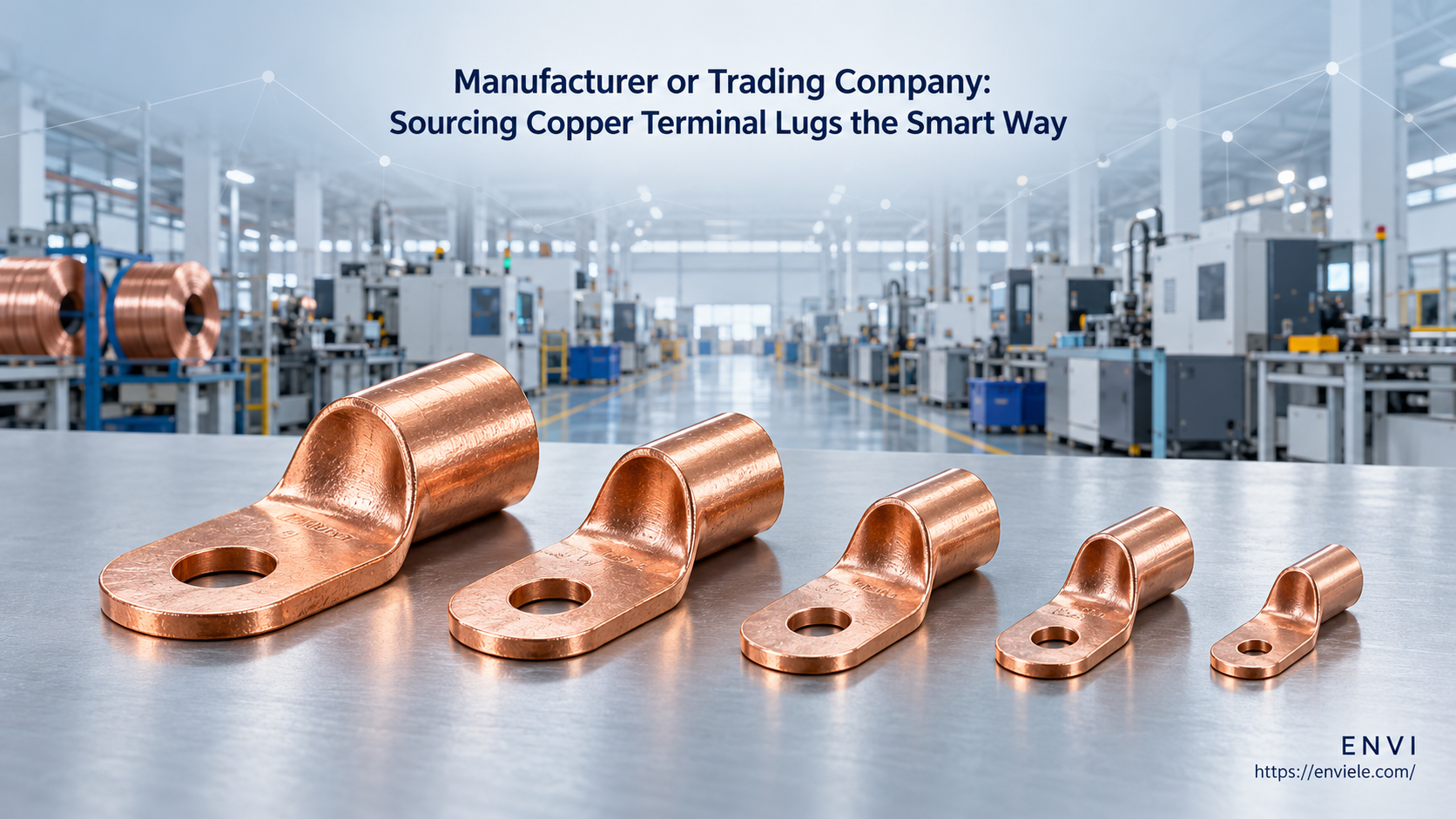
Copper terminal lugs are a mature product. Dozens of factories in Zhejiang, Jiangsu and Guangdong make them to the same GB/T and DIN drawings, and hundreds of trading companies will quote them within a day. That abundance makes the sourcing decision feel like a price comparison, and it is not. The channel you choose determines who owns the process, who absorbs a defect, how fast a drawing change can happen, and how much of the coordination work lands on your team.
This article breaks down what each model actually controls, compares them on the four criteria buyers care about, and sets out the order scenarios where each one wins.
Four cost and risk centres sit inside the factory gate. Whoever controls them controls your outcome.
Copper is 70–85 % of a lug’s material cost, and copper prices move daily. A manufacturer buying T2 copper by the tonne against a mill contract has a different cost base from a trader buying finished parts in small lots. It also has a different material risk: the factory knows which heat its coil came from, while the trader knows only which factory supplied the carton.
This is where substitution happens quietly. Brass or copper-alloy scrap blended into a melt can pass a visual inspection and fail a conductivity check. A factory with a mill relationship has an incentive to protect that relationship; a spot purchase has no such anchor.
Drawing, cutting, forming, annealing, machining, deburring and plating. Each step has tolerance stack-up, and the annealing step in particular decides whether the barrel crimps cleanly or cracks. When the process is in-house, a change request is a tooling or parameter change. When it is outsourced, a change request is a negotiation with a third party who has other customers.
In-process checks, batch retention and a non-conformance procedure only work if the person running them can stop the line. In a factory, that authority exists. In a trading relationship, inspection happens after the goods are made, which means defects are detected rather than prevented.
Every intermediary adds a margin and a coordination cost. That is not automatically bad value — coordinating six factories across three provinces is real work — but it should be paid for deliberately, not discovered in a landed-cost calculation after the first shipment.
The trading model exists because it solves four problems that factories are structurally bad at.
A single order for a panel builder might need lugs, cable glands, heat-shrink, marker tags and DIN rail. No single factory makes all of it. A trader assembles the shipment, which removes five purchase orders, five sets of shipping documents and five arrival dates from your workload.
Consolidation, export documentation, customs classification, insurance and freight booking are administrative skills, not manufacturing ones. For a buyer without an in-house import function, outsourcing that layer is often cheaper than building it.
Traders hold stock or aggregate demand across clients, so they can ship 500 pieces where a factory’s setup cost would push the price up or the MOQ to 10,000. For a distributor testing a new line, that flexibility has real value.
A maintenance team that needs 200 lugs in three sizes this month is not an attractive factory customer. It is an ideal trader customer. Paying a margin for someone else to hold the inventory and split the carton is rational.
Order volume unclear?
Tell us your annual usage and the number of part numbers. ENVI will tell you honestly whether a factory-direct arrangement beats a trader for your pattern — including when it does not.
The four criteria that decide most sourcing decisions, compared honestly.
| Criterion | China lug manufacturer | Trading company |
|---|---|---|
| Price | Lower on repeat volume; copper priced against mill contracts. Small orders can be worse than a trader’s because of setup cost. | Higher per unit, but competitive on small mixed orders where consolidation absorbs freight. |
| Lead time | Predictable and controllable — the schedule is the factory’s own. Custom tooling adds a defined setup period. | Shorter for stock items, longer and less controllable for anything made to order, because two schedules must align. |
| Customization | Strong: palm geometry, stud spacing, marking, packaging, plating thickness. Tooling is in-house. | Limited to what the chosen factory will accept; a second negotiation layer on every change. |
| Accountability | Direct. A defect is traceable to a batch, a line and a parameter, and the remedy is inside the same company. | Indirect. The trader mediates between you and a factory you may never contact. |
Comparing unit prices across channels is misleading because the two quotes usually cover different scopes. A factory quote may exclude export packing, inland freight and documentation; a trader quote may bundle them. Build a landed-cost comparison on the same Incoterm, with the same inspection scope and the same payment terms, before drawing a conclusion.
| Order pattern | Better channel | Reason |
|---|---|---|
| 20,000 pcs, 3 part numbers, annual contract | Manufacturer | Volume absorbs setup; direct process control |
| 2,000 pcs across 12 categories | Trading company | Consolidation beats per-unit savings |
| Custom palm, private label, 8,000 pcs | Manufacturer | Tooling and marking must be owned |
| 300 pcs urgent, stock sizes | Either — stock decides | Whoever holds inventory wins on speed |
| First order, unproven design | Manufacturer, small trial | Test the process, not just the part |
Six situations make factory-direct the stronger choice:
1. Your specification is stable. If the drawing has not changed in a year and your forecast is visible, the factory can plan material and tooling around you — and pass the efficiency back as price.
2. You need a non-standard part. Custom palm width, offset stud holes, laser-marked part numbers, non-standard plating thickness. Every one of these is a process change, so it belongs with the process owner. The customized product range exists for exactly this.
3. Consistency is contractual. If your customer audits you on incoming material traceability, you need a supplier who can trace to the mill heat. Our guide to storing copper terminal lugs is written for that same traceability chain.
4. You are consolidating a product family. A manufacturer that makes lugs, crimp terminals and mechanical connectors lets one PO cover several lines — for example the SC tinned copper terminal lugs together with mechanical shear-bolt lugs.
5. A defect would be expensive. Where the cost of a bad joint dwarfs the price difference — substations, data-centre power, marine — paying for direct accountability is the cheaper option.
6. You want a design partner. Factories that have made a part for thirty years will tell you when your drawing is wrong. Traders will make what you asked for.
Four situations make the trading model the rational choice:
1. The order is broad and shallow. Many categories, small quantities each. One consolidated shipment beats twelve supplier relationships.
2. You have no import function. If your team has never booked a container or classified a HS code, the trader’s documentation service is the product you are buying.
3. You are testing a market. For a first container into a new territory, the flexibility of buying mixed stock without committing to tooling or annual volumes is worth the margin.
4. You need one throat to choke. Some buyers prefer a single accountable counterparty for the whole shipment, even at a premium, because escalation is simpler than managing five factories.
What the trading model cannot give you is process control. If your specification includes a plating thickness range, a wall thickness tolerance or a type-test requirement on a specific model, verify that the trader can pass those requirements through to the factory in writing — and that someone will inspect against them, not just forward the certificate.
On repeat volume with a stable specification, usually yes — typically 8–15 % lower at the same scope — because one margin layer is removed and material is bought against mill contracts. On small, mixed or urgent orders the advantage often disappears, because setup cost and freight consolidation favour the trader. Always compare landed cost, not unit price.
Manufacturers can, and it is one of their main advantages: palm geometry, stud spacing, marking, packaging and plating thickness are all tooling or parameter changes inside the same plant. Trading companies can arrange customization only to the extent their factory partners accept it, which adds a negotiation layer and usually a longer sample loop.
Usually a supplier or trader, unless the manufacturer holds that size in stock. A factory’s price includes setup; at a few hundred pieces the setup dominates. If you are small but growing, ask the factory for a stock-item trial order first, then move to production quantities once the spec is fixed.
Ask for the business licence scope, a live video walkthrough of the production line, the names of the machines that will make your part, and a mill certificate for the copper. Then request that a sample be made and inspected against your drawing. A real factory answers all four without hesitation; an intermediary forwards the questions.
The manufacturer-versus-trader question has no universal answer, but it has a clear decision rule. If your order is repeatable, your specification is stable, and the cost of a defect is high, go factory-direct and pay for process control. If your order is broad, small or exploratory, and coordination is the real constraint, a trading partner earns its margin.
What should never happen is choosing the channel by unit price alone. The two quotes rarely cover the same scope, and the difference in total cost — freight, inspection, rework, coordination hours — usually exceeds the difference in unit price. Run the landed-cost comparison, then choose the model that matches how you actually buy.
Factory-direct, without the friction
ENVI has manufactured copper and aluminium cable lugs in Zhejiang since 1995 — in-house drawing, forming, plating and inspection, with exported documentation handled by the same team. Trial orders from 1,000 pieces.
Compression vs mechanical lugs: which is better for your business
10 industries that rely on cable lugs
Copper terminal lugs vs ferrules
About ENVI’s manufacturing

With extensive experience, excellent craftsmanship, and superior customer service, we meet various technical requirements to satisfy our customers and have gained widespread