Quick answer
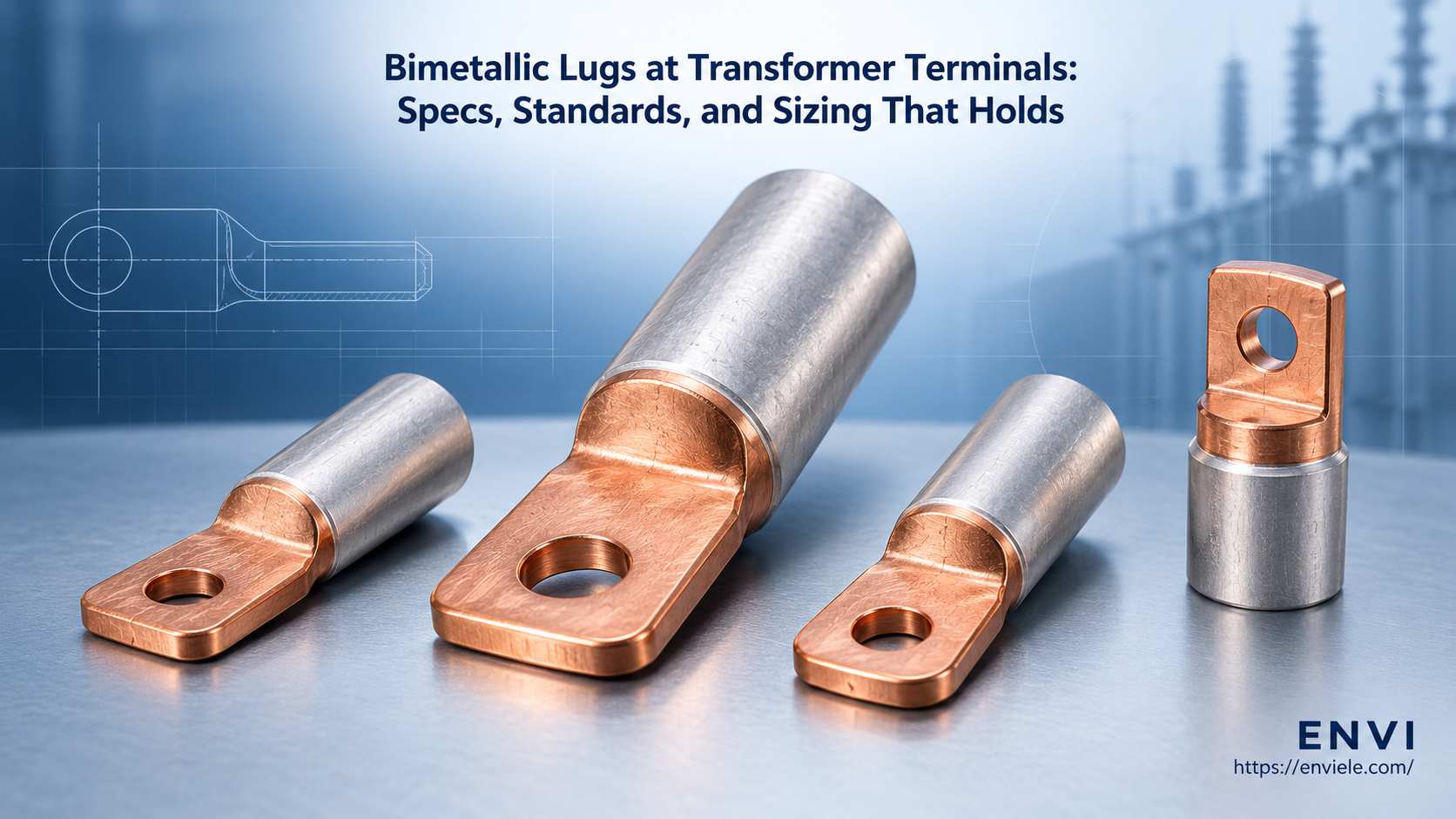
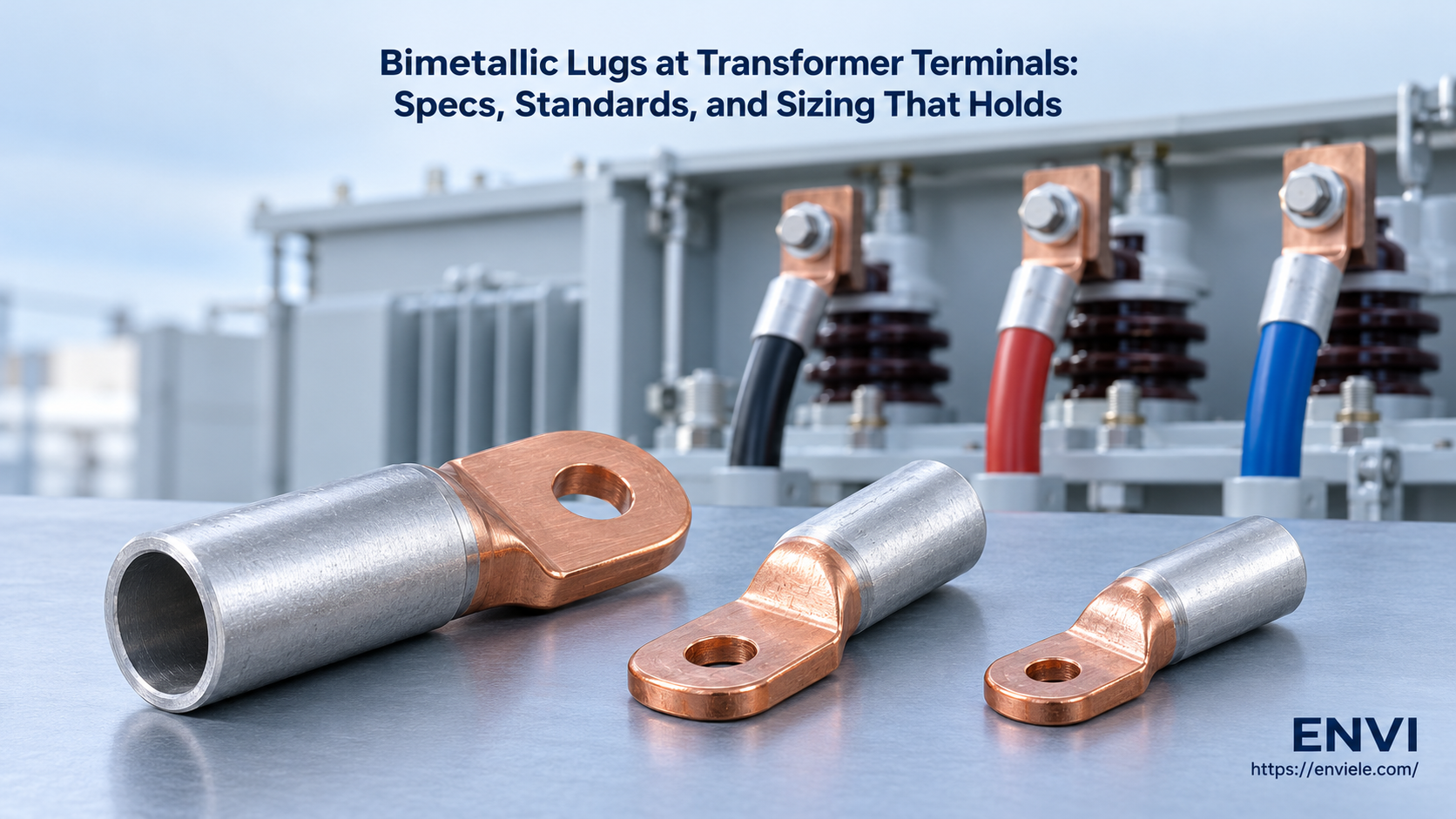
A transformer terminal almost always pairs an aluminium cable with a copper or brass bushing stud, which means the joint needs a bimetallic transition made in the factory, not in the field. Use a friction-welded DTL lug with an aluminium barrel for the conductor and a copper palm for the stud, sized on three values — conductor cross-section, stud thread (M8, M10, M12) and continuous current — then install with anti-oxidant compound on the aluminium side only, at the equipment maker’s torque, sealed against moisture. Verify the batch to IEC 61238-1 or GB/T 14315.
Nearly every transformer terminal failure traced back to a lug has the same root: someone tried to save a part number by bolting copper to aluminium.
A distribution transformer is the most expensive single item on most LV networks, and the joint that connects it to the cable is the cheapest. That imbalance is why the terminal deserves more engineering attention than it usually gets. This guide covers the electrical reason the Cu-Al transition is necessary, the construction of a DTL lug, the sizing logic for conductor and stud, the standards that separate a tested part from a claimed one, and the installation details that decide whether the joint is still at ambient temperature after ten years of load cycling.
In this guide
1. Why transformer terminals need a Cu-Al transition
2. What a bimetallic DTL lug is
3. How to size the lug
4. Standards and tests
5. Correct and safe installation
6. FAQs
Two physical facts make the direct connection unsuitable, and they reinforce each other.
Fact one: aluminium is anodic to copper. In the galvanic series, copper sits on the noble side and aluminium far toward the active side. When the two are in electrical contact and any electrolyte is present — condensation, rainwater, washing water, even humid air with dissolved salts — a galvanic cell forms and the aluminium corrodes preferentially. The damage concentrates at the contact interface, exactly where the current has to pass. Contact resistance rises, the joint runs hotter, and the heat accelerates the corrosion. Field inspections of failed joints routinely find white aluminium corrosion product packed around the stud.
Fact two: the two metals expand differently. Copper expands at roughly 17 × 10-6/K and aluminium at about 23 × 10-6/K — a difference of about 35 %. A 100 mm aluminium palm heated through a 60 K load cycle grows around 0.14 mm more than the copper member it is clamped against. Every daily cycle works the bolt, and the clamp force that held the joint gastight slowly reduces. Once the interface is no longer gastight, moisture enters and fact one takes over.
A bimetallic lug removes both mechanisms by moving the copper-aluminium interface inside the factory, where it can be made as a metallurgical weld instead of a bolted contact. The field joint then becomes aluminium-to-aluminium (barrel and conductor) and copper-to-copper (palm and stud). Neither of those couples has a galvanic problem, and both sides expand at the same rate.
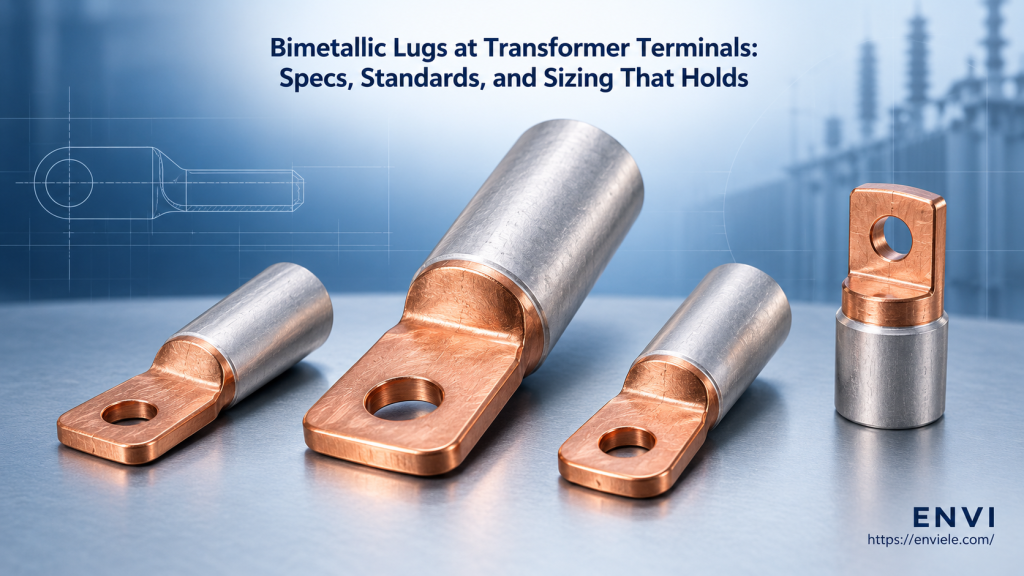
DTL is the standard Chinese designation for a copper-aluminium transition cable lug: D for cable lug, T for copper, L for aluminium. The part is a single integrated component with an aluminium barrel at one end and a copper palm at the other, joined by friction welding.
In friction welding, one part is rotated against the other under axial force. The friction raises the interface above the recrystallisation temperature of both metals without melting them, the two surfaces are simultaneously cleaned by the relative motion, and the applied force forges them together as the rotation stops. The result is a continuous metallurgical bond with a narrow intermetallic zone, typically a few micrometres thick.
That narrow zone is the whole point. Copper and aluminium form brittle intermetallic compounds — CuAl₂ and Cu₉Al₄ among others — and those compounds are both hard and poorly conductive. A friction weld keeps the layer thin and continuous; a brazed or soldered joint produces a much thicker, more brittle layer; a bolted joint has no bond at all and relies on contact pressure across an interface that is slowly corroding.
A bolted copper-to-aluminium joint fails in a predictable sequence: the bolt loses preload through differential expansion, moisture enters the now-non-gastight interface, galvanic corrosion consumes the aluminium face, contact resistance climbs, the joint runs hotter, and the higher temperature accelerates both the corrosion and the relaxation. The progression is visible in thermal surveys as a joint that was 5 K above ambient in year one and 35 K above ambient in year four. Our article on preventing galvanic corrosion at copper-to-aluminium joints covers the chemistry in more depth.
The base family covers most terminals. Three variants solve specific field problems: the double-hole version for transformer LV studs where cable weight would otherwise rotate a single-bolt palm; the small-head version for compact bushings and tight phase spacing; and the brazed-seam version for applications that want a fully sealed barrel. The DTL bimetallic copper-aluminium cable lug is the standard reference, the DTLS double-hole bimetal lug covers the bolted-transformer case, and the DTLX small-head lug handles restricted clearances.
Sizing a transformer terminal?
Send the transformer rating, bushing stud thread and cable cross-section. ENVI will return the DTL model number, crimp die and torque value in one reply.
Three values decide the part number. Two of them are on the cable drawing; the third is on the transformer nameplate.
The barrel must match the nominal cross-section of the aluminium conductor, and match its strand class as well. A DTL barrel designed for compacted stranded conductor will not close properly on a flexible conductor of the same nominal area, because the actual diameter differs by several millimetres. Specify both: cross-section and strand construction.
Distribution transformer LV bushings are typically M10 or M12; smaller metering and auxiliary terminals are M8. The hole is normally 0.5–1.0 mm larger than the thread, and the palm width must clear the bushing skirt and the phase barrier. On a single-bolt terminal, check the anti-rotation feature — a double-hole palm or a keyed washer — because an aluminium cable hanging from a 240 mm² conductor generates real torque at the stud.
The lug must carry the transformer’s rated secondary current with margin for overload, and it must do so at the ambient temperature inside the terminal enclosure, which is often 10–15 K above site ambient. Because the aluminium barrel has about 61 % of copper’s conductivity, a DTL lug for a given current is physically larger than the equivalent copper lug. Never compensate for a marginal lug by raising the conductor size alone — the barrel is the bottleneck.
| Al conductor (mm²) | Typical DTL model | Stud | Indicative current |
|---|---|---|---|
| 35 | DTL-35 | M8 | ~110 A |
| 95 | DTL-95 | M10 | ~205 A |
| 185 | DTL-185 | M12 | ~340 A |
| 300 | DTL-300 | M12 / M16 | ~450 A |
Indicative values for single-core aluminium cable in air at 30 °C ambient. Use the transformer’s rated secondary current plus the applicable overload factor, and confirm against the supplier’s type-test data for the exact model.
A bimetallic lug has an extra failure mode that a single-metal lug does not: the weld itself. That makes test evidence more important, not less.
The core type-test standard for compression and mechanical connectors on power cables. Three test groups matter to a transformer terminal:
Mechanical. A tensile load is applied to the completed joint and must be held without pull-out or conductor slip, with the pass level scaled to conductor cross-section.
Heat cycle. The joint is loaded and cycled through repeated heating and cooling, with resistance measured at intervals. The acceptance criterion is not merely “no failure” but that resistance stays stable relative to the reference conductor — this is the test that exposes a weld with excessive intermetallic growth or a barrel with insufficient wall thickness.
Short-circuit. A specified fault current is passed for a defined duration, after which the joint must still meet its resistance requirement. Transformer LV terminals see high prospective fault current, so this test is directly relevant to the application rather than academic.
GB/T 14315 covers compression-type copper and aluminium terminal lugs and connecting tubes for power cable conductors, defining dimensions, material requirements and test methods. GB/T 2314 and GB/T 2317 series apply to the broader power fitting family for general technical requirements and test methods. For export projects, the buyer’s national standard or the IEC document usually governs, but a Chinese manufacturer should be able to show GB/T conformance as the baseline.
The practical test for a buyer is simple: ask for the report, read the standard number and the class, and check that the model tested matches the model quoted. A report for a different cross-section range is not evidence for the part you are buying. Our checklist of seven factors for selecting bimetallic cable lugs expands on this evaluation.
A tested lug installed badly is a tested lug that fails. Three steps carry most of the risk.
 A technician tightening a cable lug terminal with a click torque wrench beside a tube of anti-oxidant compound.
Aluminium oxide forms within seconds of abrading the surface and is electrically insulating. The correct procedure is to wire-brush the conductor and barrel bore, apply a thin film of jointing compound to the aluminium conductor and barrel, and crimp immediately so the compound is displaced rather than trapped. Compound on the copper palm is unnecessary and can contaminate the contact face; compound squeezed onto the palm should be wiped off before the joint is bolted.
The compound does two jobs: it excludes air and moisture from the strand interstices, and its metallic or carbon filler maintains conductivity across any oxide the brush did not remove. A thin, even film is correct. A thick blob is not — excess compound hydro-locks in the barrel and can prevent the conductor seating fully.
Use a calibrated torque wrench, not a feel judgment. The values below are typical for lubricated steel studs into copper or brass terminals; equipment manufacturers’ data takes precedence, and aluminium-to-aluminium joints usually need slightly lower values to avoid crushing the palm.
| Stud | Typical torque (Cu palm) | Typical torque (Al palm) |
|---|---|---|
| M8 | 20–25 N·m | 15–20 N·m |
| M10 | 40–45 N·m | 30–35 N·m |
| M12 | 70–80 N·m | 55–65 N·m |
| M16 | 120–140 N·m | 90–110 N·m |
Re-torque aluminium joints once, 24 hours after first tightening, to recover the preload lost to creep. Record the value; unrecorded re-torque is indistinguishable from no re-torque during a later audit.
Seal the barrel entry with adhesive-lined heat-shrink or a gel-filled cover. On outdoor transformer terminals, add a phase shroud and orient the palm so water runs off rather than into the stud recess. A joint that stays dry does not corrode, regardless of the metal pair — sealing is cheaper than any material upgrade.
Photograph each completed joint, record the torque value and the crimp die used, and take a thermal image under load before handover. Ten joints and ten thermal images give you a baseline that turns a future fault from an argument into a measurement.
Because the cable is almost always aluminium and the bushing stud is copper or brass. Bolting those two metals directly creates a galvanic couple in which aluminium corrodes, and their different expansion rates loosen the joint. A bimetallic lug moves the copper-aluminium interface into a factory friction weld, leaving aluminium-to-aluminium and copper-to-copper joints in the field.
Match the aluminium barrel to the conductor cross-section and strand class, match the bolt hole to the bushing stud thread with 0.5–1.0 mm clearance, and confirm the palm width clears the bushing skirt and phase barrier. Then check that the model’s rated current covers the transformer secondary current at enclosure ambient temperature.
A DL lug is all-aluminium: an aluminium barrel and an aluminium palm, used where the terminal is also aluminium. A DTL lug is a copper-aluminium transition: aluminium barrel for an aluminium conductor, copper palm for a copper or brass terminal. Using DL on a copper stud recreates exactly the galvanic problem the DTL was designed to solve.
Yes, on the aluminium conductor and barrel. The compound is not there to protect the copper-aluminium weld — that joint is already metallurgical — it is there to break down aluminium oxide at the strand interface and exclude moisture from the barrel. Apply a thin film, crimp immediately, and wipe any excess off the copper palm before bolting.
The transformer terminal is a small joint carrying a large consequence. Aluminium cable plus copper stud means the transition has to be engineered, and the only reliable place to make it is in the factory, as a friction weld with a controlled intermetallic zone. Size the lug on conductor, stud and current; demand IEC 61238-1 or GB/T 14315 evidence for the exact model; and install it with compound on the aluminium side, a calibrated torque wrench, and a seal.
Do those four things and the joint becomes unremarkable — which, for a transformer terminal, is the highest compliment available.
DTL lugs, friction-welded in-house
ENVI produces DTL, DTLS and DTLX bimetallic lugs from T2 copper and 1050/1350 aluminium, with weld-zone inspection on every batch and type-test reports to IEC 61238-1. Custom palm geometry and stud patterns available.
What is a bimetallic cable lug and how it works
Common problems with bimetallic lugs and how to avoid them
Aluminium cable lugs: when to use pure aluminium instead of bimetallic
All cable lug series

With extensive experience, excellent craftsmanship, and superior customer service, we meet various technical requirements to satisfy our customers and have gained widespread